
Clean & Minimal AI Powered Fitness Routines
Download App25-Minute Sprained Left Ankle Rehab
Low-impact mobility + strength to restore range of motion, balance, and calf/foot control after a left ankle sprain.
25-Minute Sprained Left Ankle Rehab
Low-impact mobility + strength to restore range of motion, balance, and calf/foot control after a left ankle sprain.
Warm-Up & Mobility
Restore comfortable ankle motion and wake up the foot without aggravating the sprain. Gentle approach.
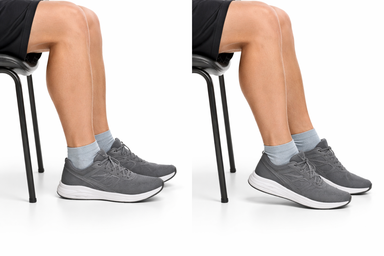
How to
A simple ankle movement that warms your calves and shins and moves both ankles through flex and point.
- Sit or lie down with both legs extended and relaxed.
- Pull your toes toward your shins on both feet.
- Point your toes away from you on both feet.
- Move smoothly back and forth for the set.
- Keep your knees still
- Use a full, smooth range
- Bouncing or jerking the ankles
- Letting your legs tense up
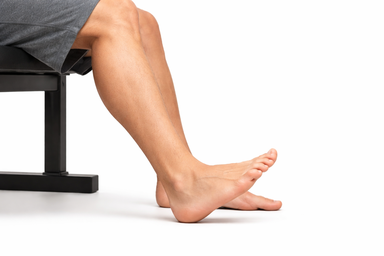
How to
A simple ankle mobility drill where you trace letters with your foot to move the ankle in many directions.
- Sit tall or lie down with one leg extended.
- Lift one foot slightly off the floor.
- Use your big toe to trace the alphabet in the air.
- Move from the ankle, not from your whole leg.
- Finish the alphabet, then switch sides.
- Keep the movement slow and controlled.
- Make each letter as large as you can.
- Swinging your whole leg to draw the letters.
- Rushing through the alphabet.
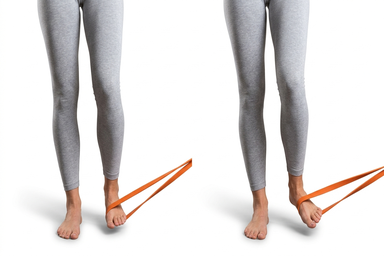
How to
A controlled ankle movement that trains the inner lower leg and ankle control.
- Sit tall with one leg extended and your heel on the floor.
- Keep your leg still and turn the sole of your foot inward.
- Pause briefly, then return your foot to neutral.
- Finish your reps, then switch sides.
- Move only at the ankle.
- Keep your knee still.
- Rotating your whole leg instead of your ankle.
- Rushing or snapping back to neutral.
How to
A controlled ankle move that turns your foot outward to train the muscles on the outside of your lower leg.
- Sit tall with one leg extended and your heel resting on the floor.
- Keep your knee still and toes pointing up.
- Turn the sole of your foot outward as far as you can control.
- Return slowly to the start position.
- Finish your reps, then switch sides.
- Move only at the ankle.
- Keep the motion slow.
- Letting your knee roll with your foot.
- Snapping back to the start position.
Foot Intrinsics & Calf Strength
Keep the arch active; don't let the ankle collapse inward.
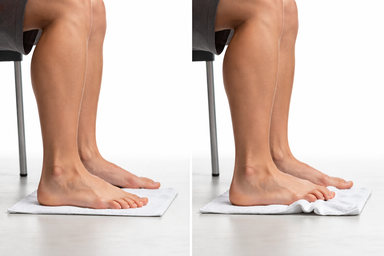
How to
A seated toe exercise that trains the small muscles of your feet and arches.
- Sit tall with both feet flat on a towel.
- Keep your heels down and scrunch the towel toward you with your toes.
- Release your toes and spread them back out.
- Repeat until you finish the set.
- Keep your heels planted
- Move from your toes, not your ankles
- Lifting your heels off the floor
- Curling your whole foot instead of using your toes
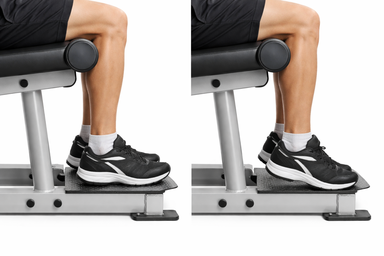
How to
A seated lower-leg move that trains your calves by lifting your heels against resistance.
- Sit tall with feet flat and knees bent about 90 degrees.
- Place weight on your thighs, or use bodyweight only.
- Press through the balls of your feet and lift both heels high.
- Pause briefly at the top.
- Lower your heels with control and repeat.
- Keep your toes planted
- Lift straight up, not out
- Bouncing through the reps
- Letting your feet roll to the outside
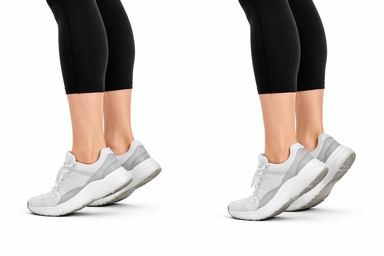
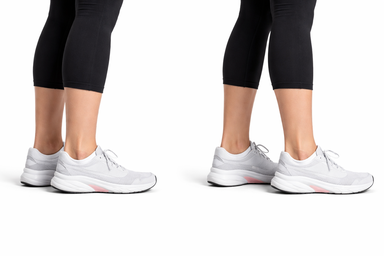
How to
A standing lower-leg move that trains your calves by lifting and lowering your heels.
- Stand tall with feet hip-width apart and toes pointing forward.
- Press through the balls of your feet and lift your heels high.
- Pause briefly at the top without leaning forward.
- Lower your heels with control to the floor.
- Keep your knees softly straight.
- Rise straight up, not forward.
- Bouncing through the reps.
- Letting your ankles roll outward.
Functional Loading
Slow, controlled reps. Keep weight evenly distributed through the foot.
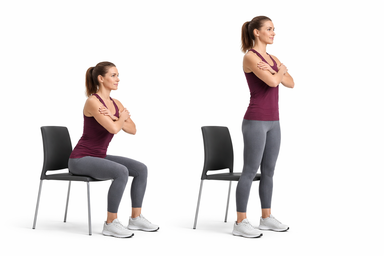
How to
A chair-based squat pattern that trains your thighs and glutes for standing strength.
- Sit near the front of a chair with feet flat and hip-width apart.
- Lean slightly forward and brace your core.
- Press through both feet and stand tall.
- Push your hips back and sit down with control.
- Keep your knees tracking over your toes
- Stand tall at the top
- Letting your knees cave inward
- Dropping hard onto the chair

How to
A side-to-side weight shift that warms up your hips, legs, and balance.
- Stand with your feet wider than hip-width and toes pointing forward.
- Shift your weight to one side and bend that knee slightly.
- Keep the other leg long and both feet flat on the floor.
- Push through your bent leg to shift back across to the other side.
- Move side to side with control for each rep.
- Keep your chest lifted
- Keep both feet planted
- Letting your knee cave inward
- Lifting your heel as you shift
Balance & Cool-Down
Re-train stability and finish with controlled holds (no aggressive stretching).
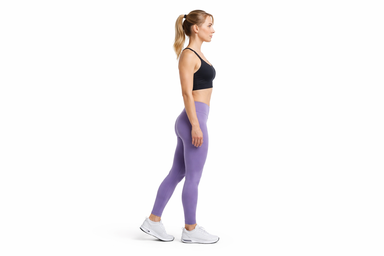
How to
A narrow heel-to-toe balance hold that trains steady posture and control.
- Stand tall near support if needed.
- Place one foot directly in front of the other, heel to toe.
- Keep your weight even and eyes forward.
- Hold the stance and breathe slowly.
- Stand tall through your head
- Keep your feet in one line
- Leaning your body to one side
- Looking down the whole time

How to
A one-leg standing hold that trains balance and stability in your foot, ankle, and hips.
- Stand tall with feet hip-width apart and arms relaxed.
- Shift your weight onto one foot and lift the other foot off the floor.
- Hold steady, keep your torso tall, and breathe slowly.
- Lower your foot with control, then switch legs.
- Keep your hips level
- Look at one spot ahead
- Letting your hips twist or drop
- Holding your breath

Inversion vs. Eversion: Retraining the Sprain Patt
Most ankle sprains damage the lateral ligaments through forced inversion, so pairing Ankle Inversion and Eversion directly reconditions the peroneals and tibialis posterior through their full active range. Towel Scrunches recruit the intrinsic foot muscles that stabilize the arch and offload stress from the injured lateral structures during every step.

Why Proprioception Is the Real Injury
A sprained ankle doesn't just tear ligament fibers — it destroys mechanoreceptors that tell your nervous system where your foot is in space. Single-Leg Balance and Tandem Stance directly challenge that neuromuscular feedback loop, rebuilding the reflexive stability that prevents re-sprain, which occurs in nearly half of all lateral ankle injuries.

Seated Before Standing: The Load Progression Logic
Seated Calf Raises isolate soleus under low axial load before Standing Calf Raises recruit gastrocnemius with full bodyweight — a deliberate progression from protected to functional loading. Lateral Weight Shifts and Sit-to-Stand then transfer that isolated strength into multi-planar, real-world movement patterns. Adjust Single-Leg Balance hold time (10–30 seconds) as your primary intensity lever