
Clean & Minimal AI Powered Fitness Routines
Download AppIntermediate Kettlebell Training
A 25-minute kettlebell session focused on strength + conditioning with clean technique and controlled pace.
Intermediate Kettlebell Training
A 25-minute kettlebell session focused on strength + conditioning with clean technique and controlled pace.
Warm-Up
Prime shoulders/hips and rehearse hinge and squat patterns. 5 minutes.
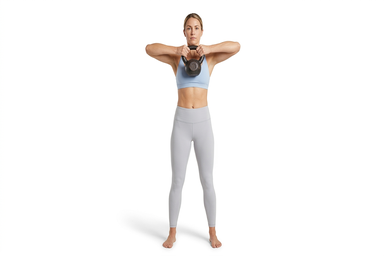
How to
A standing shoulder and core move where you circle a weight around your head with control.
- Stand tall with feet about hip-width and hold one weight at your chest.
- Brace your core and bring the weight beside one ear.
- Circle it slowly behind your head and around the other side.
- Return the weight to your chest, then repeat in the other direction.
- Keep your ribs down
- Move slow and smooth
- Arching your back as the weight goes behind you
- Letting the weight drift far from your head
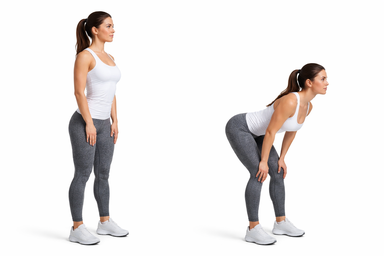
How to
A standing hip hinge that trains your glutes and hamstrings and builds the pattern for deadlifts.
- Stand with feet hip-width apart and knees slightly bent.
- Brace your core and keep your chest open.
- Push your hips back as your torso tips forward.
- Lower until you feel your hamstrings, keeping your back flat.
- Drive your hips forward to stand tall again.
- Move from your hips, not your waist.
- Keep your back long.
- Squatting instead of hinging your hips back.
- Rounding your back as you lower.
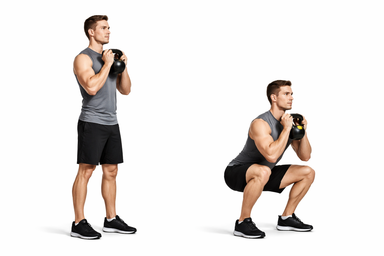
How to
A front-loaded squat that trains your quads, glutes, and core.
- Hold the kettlebell at your chest with both hands.
- Stand with feet about shoulder-width apart, toes slightly out.
- Bend your knees and hips to squat down under control.
- Lower until your thighs are near parallel, or as far as comfortable.
- Drive through your feet to stand tall again.
- Keep your chest up
- Knees track over toes
- Letting your knees cave inward
- Rounding your back at the bottom
Main Workout
Strength and conditioning circuit with unilateral work and core stability. 18 minutes.
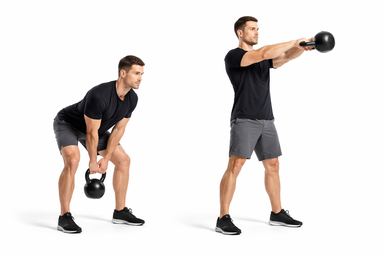
How to
A two-hand kettlebell swing that trains your glutes, hamstrings, hips, and core.
- Stand with feet hip-width and the kettlebell on the floor in front of you.
- Hinge at your hips, grip the handle, and hike it back between your legs.
- Snap your hips forward and let the kettlebell swing to chest height.
- Let it fall, hinge again, and keep the swings smooth.
- To finish, guide it back to the floor in front of you.
- Keep your back flat
- Drive the swing with your hips
- Squatting instead of hinging
- Lifting the kettlebell with your arms
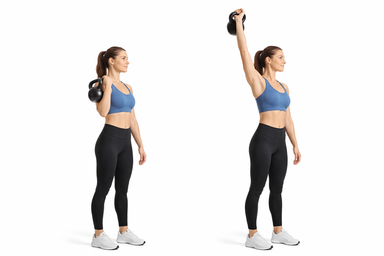
How to
A one-arm overhead press with a kettlebell that trains your shoulders, triceps, and core.
- Stand tall with the kettlebell racked at one shoulder.
- Brace your core and keep your wrist stacked over your elbow.
- Press the kettlebell overhead until your arm is straight.
- Lower it with control back to your shoulder.
- Finish your reps, then switch sides.
- Keep your ribs down.
- Press in a straight line.
- Leaning back to finish the press.
- Letting the kettlebell pull your wrist back.
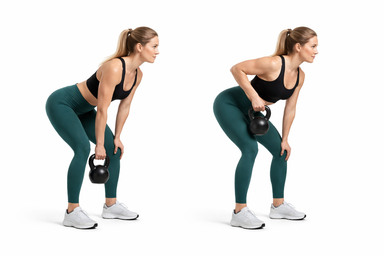
How to
A one-arm rowing move that trains your upper back, lats, and arms.
- Stand hinged at your hips with one hand braced and a kettlebell in the other.
- Let the kettlebell hang under your shoulder with your back flat.
- Pull your elbow up and back until the kettlebell reaches your ribs.
- Lower it with control to the start position.
- Finish your reps, then switch sides.
- Keep your chest facing the floor.
- Pull your elbow toward your hip.
- Twisting your torso as you row.
- Shrugging your shoulder toward your ear.
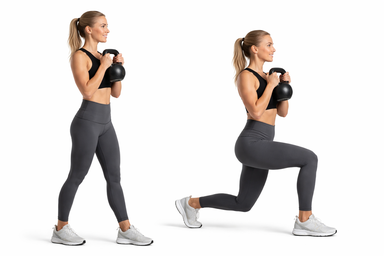
How to
A loaded reverse lunge that trains your legs and glutes while challenging balance.
- Hold the kettlebell at your chest or by your sides.
- Stand tall with feet hip-width apart.
- Step one foot back and lower until both knees bend.
- Push through your front foot to stand back up.
- Finish your reps, then switch legs.
- Keep your chest tall
- Keep your front knee over your foot
- Letting your front knee cave inward
- Pushing off the back foot to stand
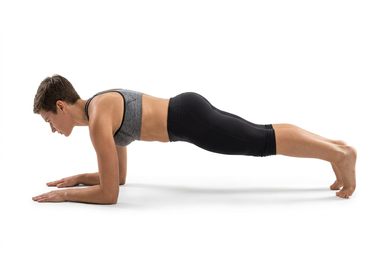
How to
A core hold that trains your abs, shoulders, and glutes while you keep a straight body line.
- Place your forearms on the floor with elbows under shoulders.
- Step both feet back and lift into a straight line from head to heels.
- Brace your abs and squeeze your glutes.
- Hold the position and breathe steadily.
- Lower your knees to the floor to finish.
- Keep your ribs pulled down
- Push the floor away
- Letting your hips sag
- Lifting your hips too high
Cool-Down
Downshift breathing and release hips/back. 2 minutes.
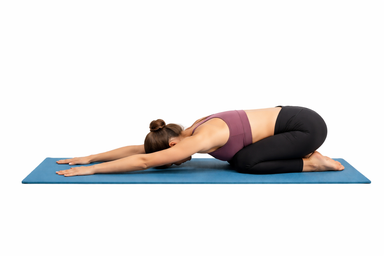
How to
A kneeling rest stretch that relaxes your back, hips, and shoulders while you breathe.
- Kneel with your big toes together and knees apart.
- Sit your hips back toward your heels.
- Reach your arms forward and lower your chest to the floor.
- Rest your forehead down and relax your neck.
- Hold the stretch and breathe slowly.
- Let your hips sink back
- Keep your neck relaxed
- Forcing your hips down
- Holding your breath
How to
A standing hip hinge that trains your glutes and hamstrings and builds the pattern for deadlifts.
- Stand with feet hip-width apart and knees slightly bent.
- Brace your core and keep your chest open.
- Push your hips back as your torso tips forward.
- Lower until you feel your hamstrings, keeping your back flat.
- Drive your hips forward to stand tall again.
- Move from your hips, not your waist.
- Keep your back long.
- Squatting instead of hinging your hips back.
- Rounding your back as you lower.

Hip Hinge First, Everything Else Second
The Hip Hinge and Kettlebell Swing share the same posterior chain recruitment pattern — loading glutes, hamstrings, and spinal erectors through a powerful hip extension. Placing the Hinge in warm-up primes the exact motor pattern the Swing and Clean demand, so your nervous system is already dialed in before load is introduced.

The Ballistic-Grind Ratio Kettlebells Demand
Kettlebell training uniquely blends ballistic movements (Swing, Clean) with grinding strength work (Goblet Squat, Overhead Press, Row), requiring your body to shift between explosive hip drive and slow-twitch stabilization within the same session. This dual demand on both fast and slow motor units is what separates kettlebell conditioning from conventional dumbbell or barbell training.

Stacking Volume Before Intensity Pays Off
The sequencing here follows a deliberate load progression — Goblet Squat and Swing build volume before the more technically complex Clean and Overhead Press arrive. As you adapt, increase bell weight only when you can complete the Reverse Lunge and Row with zero compensatory lean; those two exercises expose asymmetries that heavier loads will otherwise amplify.