
Clean & Minimal AI Powered Fitness Routines
Download App25-Minute Shoulder External Rotation Mobility
An intermediate mobility session to improve shoulder external rotation with control and gentle strength.
25-Minute Shoulder External Rotation Mobility
An intermediate mobility session to improve shoulder external rotation with control and gentle strength.
Warm-Up & Scapular Control
Increase blood flow and set the shoulder blade position to support external rotation.
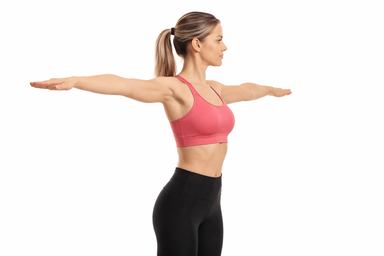
How to
A simple shoulder warm-up that moves both arms in circles and trains shoulder control.
- Stand tall with your feet about hip-width apart.
- Raise both arms out to your sides at shoulder height.
- Make small, controlled circles with both arms.
- Keep circling for the set time, then reverse direction if told.
- Lower your arms to finish.
- Keep your ribs down
- Move smoothly, not fast
- Shrugging your shoulders toward your ears
- Arching your back to keep the arms up
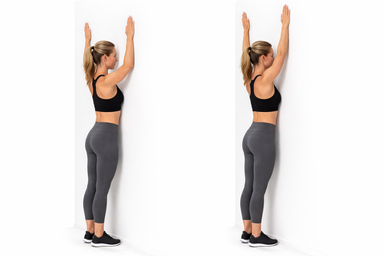
How to
A wall-based shoulder slide that trains upper back control and shoulder movement.
- Stand with your back to a wall and feet a small step away.
- Press your ribs, upper back, and head gently toward the wall.
- Set your arms in a goalpost shape with elbows and wrists near the wall.
- Slide your arms up the wall without shrugging.
- Slide back down to the start and repeat.
- Keep your ribs down
- Move slow and smooth
- Arching your lower back to reach higher
- Shrugging your shoulders toward your ears
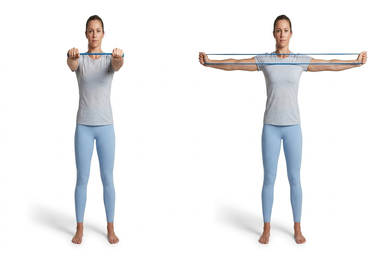
How to
A band upper-back move that trains your rear shoulders and mid-back.
- Stand tall and hold a band at chest height with both hands.
- Start with arms straight and hands shoulder-width apart.
- Pull the band apart until your hands move out to your sides.
- Pause briefly with shoulder blades squeezed together.
- Control the band back to the start and repeat.
- Keep your ribs down.
- Move from your shoulders, not your lower back.
- Shrugging your shoulders toward your ears.
- Arching your back to finish the pull.
Strength Block
Use light tension. Elbow stays pinned to your side for band work; move only at the shoulder.
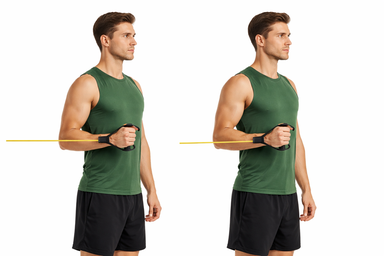
How to
A one-arm band rotation that trains your shoulder rotators.
- Stand tall with the band at your side and elbow bent 90 degrees.
- Keep your elbow tucked to your side.
- Rotate your forearm outward against the band.
- Slowly return to start under control.
- Finish your reps, then switch sides.
- Keep your elbow pinned to your side
- Move only your forearm
- Letting your elbow drift away from your body
- Twisting your torso to cheat the rep
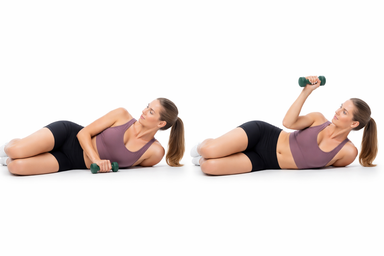
How to
A side-lying shoulder rotation that trains your rotator cuff and upper back control.
- Lie on one side with your working elbow bent 90 degrees at your ribs.
- Keep your wrist straight and rotate your forearm up toward the ceiling.
- Pause briefly at the top without rolling your body back.
- Lower with control to the start position.
- Finish your reps, then switch sides.
- Keep your elbow pinned to your side.
- Move slow and stay stacked.
- Rolling your torso back to lift higher.
- Letting your elbow drift away from your ribs.
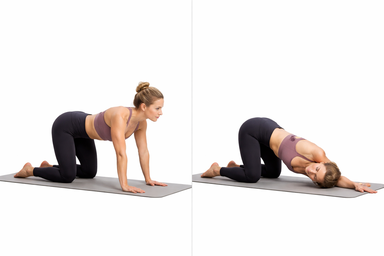
How to
A floor stretch that opens your upper back and shoulder while you hold one side at a time.
- Start on all fours with your hands under shoulders and knees under hips.
- Slide one arm under your chest, palm up, and lower your shoulder toward the floor.
- Rest your head down if comfortable, and keep your hips over your knees.
- Hold the stretch and breathe slowly.
- Press into your top hand to return to all fours, then switch sides.
- Keep your hips stacked over your knees
- Breathe into your upper back
- Letting your hips drift far to one side
- Forcing your shoulder lower than comfortable
Posterior Shoulder & Rotator Cuff Control
Keep neck relaxed; squeeze shoulder blades gently down and back.
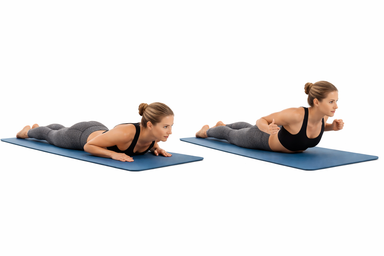
How to
A face-down upper-back hold that trains your rear shoulders and muscles between your shoulder blades.
- Lie face down with your arms bent in a W shape.
- Rest your forehead down and gently brace your core.
- Lift your elbows and hands slightly off the floor.
- Squeeze your shoulder blades down and back.
- Hold the W position and breathe steadily.
- Keep your neck long.
- Pull your shoulders away from your ears.
- Shrugging your shoulders up.
- Lifting your chest too high.
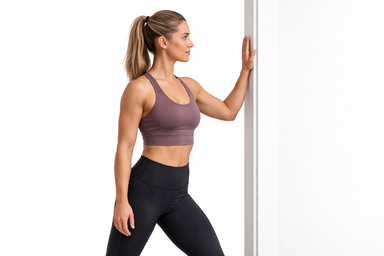
Cool-Down & Mobility Holds
Longer holds to reinforce external rotation comfort and reduce stiffness.
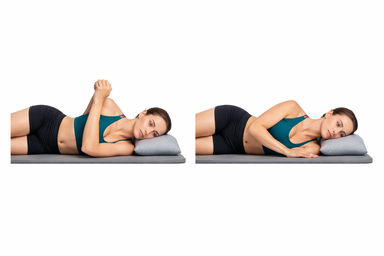
How to
A side-lying shoulder stretch that targets the back of your shoulder and rotation range.
- Lie on one side with your lower arm in front, elbow bent 90 degrees.
- Keep your shoulder down and your upper arm resting on the floor.
- Use your top hand to gently guide your lower forearm toward the floor.
- Hold the stretch and breathe slowly.
- Release gently, then switch sides.
- Keep the stretch gentle
- Do not force your shoulder
- Pressing through sharp pain
- Letting your shoulder roll forward

Why Scapular Control Unlocks Rotation
Scapular Wall Slides and Prone W directly target lower trapezius and serratus anterior — the stabilizers that must fire before true glenohumeral external rotation is safe or effective. Without this foundation, Band External Rotation and Side-Lying work train the infraspinatus and teres minor in a mechanically compromised position.

The Rotator Cuff's Hidden Demand
External rotation is the rotator cuff's most undertrained and most injury-predictive movement plane — tight posterior capsules and weak infraspinatus are behind most impingement and labral stress patterns. The Sleeper Stretch directly targets that posterior capsule stiffness, while Band Pull-Aparts reinforce the mid-scapular retraction needed for overhead clearance.

End-Range Strength Before Passive Stretch
Placing Band External Rotation and Side-Lying work before the Doorway Stretch and Thread the Needle follows the principle of earning mobility through active control first — passive range gained without strength rarely transfers. To personalize, increase Side-Lying reps on your dominant side if overhead asymmetry exists, or hold the Doorway Stretch 10 seconds longer on your tighter shoulder.