
Clean & Minimal AI Powered Fitness Routines
Download AppWrist Strength and Mobility
Wrist-only strength and mobility session to build resilient wrists and forearms with minimal back load.
Wrist Strength and Mobility
Wrist-only strength and mobility session to build resilient wrists and forearms with minimal back load.
Warm-Up
Wrist-only focus. Increase blood flow and gently take the wrists through comfortable ranges.
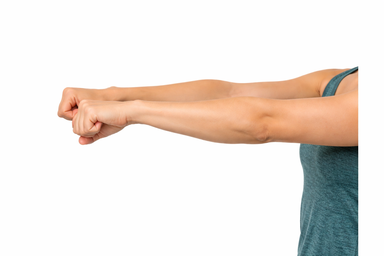
How to
A gentle wrist mobility drill that moves both wrists through circles to warm your forearms and hands.
- Stand or sit tall with your arms relaxed and elbows bent.
- Make slow circles with both wrists in one direction.
- Keep the movement smooth and controlled.
- Reverse direction and circle both wrists the other way.
- Move through a comfortable range
- Keep your shoulders relaxed
- Forcing a painful range
- Moving too fast or jerky
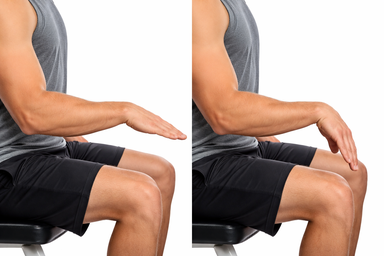
How to
A simple wrist mobility move that trains wrist flexion and extension through a controlled range.
- Sit or stand tall with both arms in front of you.
- Keep your elbows mostly still and palms facing down.
- Bend both wrists up, lifting your fingers toward you.
- Bend both wrists down, pointing your fingers away.
- Move slowly back and forth for your reps.
- Move from your wrists, not your elbows.
- Use a smooth, controlled range.
- Shrugging your shoulders as you move.
- Forcing the wrists past a comfortable range.
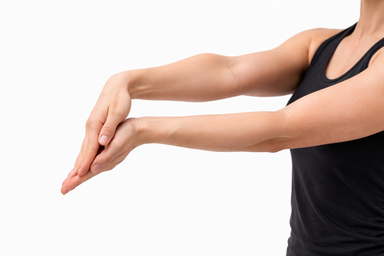
How to
A forearm stretch that targets the wrist flexors on one arm at a time.
- Extend one arm in front of you, palm up.
- Keep your elbow straight and gently pull your fingers back.
- Hold the stretch and breathe slowly.
- Release gently, then switch sides.
- Keep your shoulder relaxed
- Use gentle pressure
- Bending your elbow
- Pulling into sharp pain
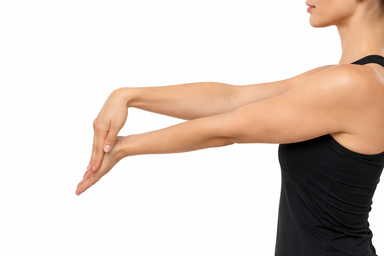
How to
A forearm stretch that targets the wrist extensors on the top of your forearm.
- Extend one arm in front with your palm down.
- Use your other hand to gently bend your wrist down.
- Keep your elbow straight and hold while breathing slowly.
- Release slowly, then switch sides.
- Use gentle pressure
- Keep your shoulder relaxed
- Forcing the wrist into pain
- Bending your elbow during the stretch
Strength Circuit
Use light-to-moderate weight. Rest as needed, but keep the pace steady.
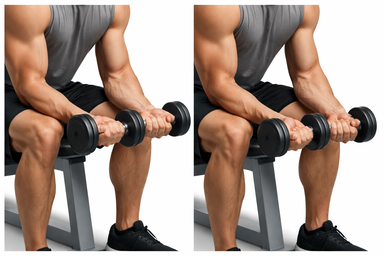
How to
A forearm exercise using dumbbells to train wrist flexion and grip muscles.
- Sit with a dumbbell in each hand, palms up, forearms resting on your thighs.
- Let your wrists hang just past your knees while keeping forearms still.
- Curl the dumbbells up by bending only your wrists.
- Lower the dumbbells slowly until your wrists bend down again.
- Repeat for your reps with both arms moving together.
- Keep your forearms pinned down
- Move only at your wrists
- Lifting your forearms off your thighs
- Using momentum instead of a slow curl
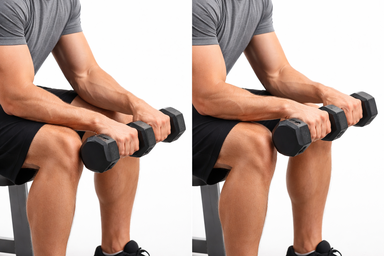
How to
A forearm exercise using dumbbells to train wrist extensors and grip control.
- Sit and hold a dumbbell in each hand with palms facing down.
- Rest your forearms on your thighs or a bench, wrists hanging off the edge.
- Curl your knuckles up by extending your wrists.
- Lower the dumbbells with control until your wrists bend down.
- Repeat for all reps with both arms moving together.
- Keep your forearms still.
- Move only at your wrists.
- Lifting your forearms off the support.
- Swinging the dumbbells to gain momentum.
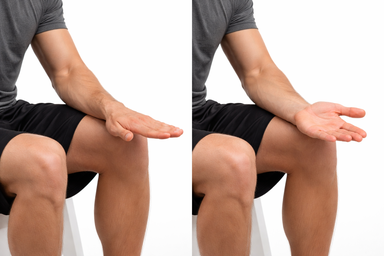
How to
A forearm rotation that trains wrist control and the muscles that turn your palm up and down.
- Sit or stand with one elbow bent at 90 degrees by your side.
- Keep your upper arm still and wrist straight.
- Turn your palm up as far as you can control.
- Turn your palm down as far as you can control.
- Finish your reps, then switch arms.
- Move slowly with control
- Keep your elbow pinned
- Letting your elbow drift away from your side
- Bending your wrist instead of rotating your forearm
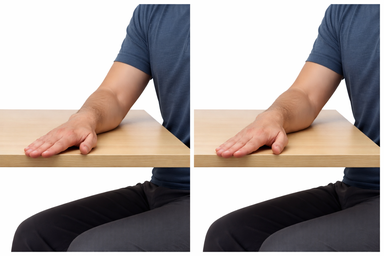
How to
A side-to-side wrist motion that trains forearm control and wrist mobility.
- Sit or stand tall with both forearms supported or held steady.
- Keep your palms facing down and fingers relaxed.
- Move both wrists toward your thumbs, then toward your pinkies.
- Use a slow, controlled range without forcing it.
- Return to center after your last rep.
- Keep your forearms still
- Move only at the wrists
- Twisting your forearms instead of moving your wrists
- Forcing a range that feels sharp or pinchy
Band Finisher
Pump work for the wrist extensors/flexors. Keep tension constant and range controlled.
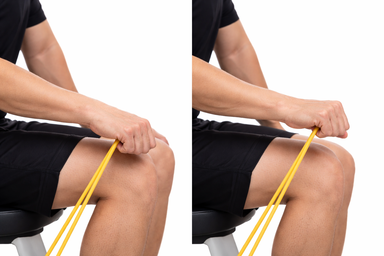
How to
A band-resisted wrist lift that trains your forearm extensors and wrist control.
- Sit tall and hold one end of the band in one hand, palm facing down.
- Pin the other end under your foot or opposite hand for light tension.
- Rest your forearm on your thigh or a bench with your wrist free.
- Lift your knuckles up, then lower your hand with control.
- Finish your reps, then switch sides.
- Keep your forearm still.
- Move only at the wrist.
- Letting your elbow or forearm lift.
- Using momentum instead of control.
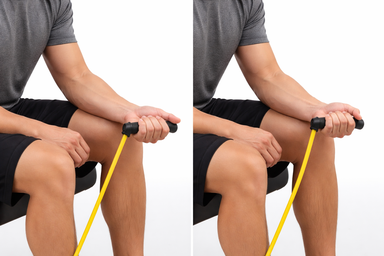
How to
A band wrist curl that trains your forearm flexors and grip control one arm at a time.
- Sit or stand with one end of the band under your foot.
- Hold the other end palm up with your forearm supported.
- Curl your wrist up against the band without moving your arm.
- Lower your hand slowly back to the start.
- Finish your reps, then switch sides.
- Keep your forearm still.
- Move only at the wrist.
- Letting your elbow or shoulder help the curl.
- Snapping the wrist down on the return.
Sumo Squat Finisher
Add a quick lower-body finisher. Keep torso tall and stay in a comfortable range.
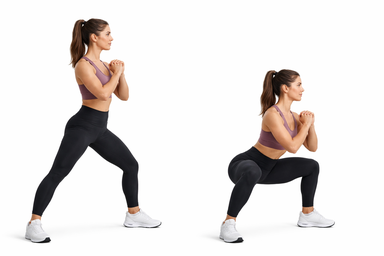
How to
A wide-stance squat that trains your quads, glutes, and inner thighs.
- Stand with feet wide and toes turned slightly out.
- Brace your core and keep your chest lifted.
- Bend your knees and hips to lower into a squat.
- Pause when your thighs are near parallel or as low as you control.
- Push through your feet to stand back up.
- Knees track over toes
- Keep your chest tall
- Letting your knees cave inward
- Rounding your back at the bottom

Why These Exercises Were Chosen
Each exercise targets specific muscle groups and movement patterns matched to the demands of your discipline. The selection balances agonist-antagonist pairs, stabilizer engagement, and energy system development to build functional capacity that transfers directly to performance.

Built Around How Your Body Works
Your routine reflects the biomechanical and physiological demands of your goal. Joint angles, contraction types, and loading patterns are chosen to strengthen exactly the positions and forces your body encounters during your activity.

Structured for Long-Term Adaptation
Set and rep schemes follow progressive overload principles, giving your tendons, muscles, and nervous system the stimulus they need to adapt. Adjust load and rest periods as movements become easier to keep driving improvement.