
Clean & Minimal AI Powered Fitness Routines
Download App10 Minute Standing Yoga
A gentle beginner standing yoga flow for posture, flexibility, and recovery with no floor work.
10 Minute Standing Yoga
A gentle beginner standing yoga flow for posture, flexibility, and recovery with no floor work.
Standing Flow
A continuous gentle standing yoga sequence focused on posture, hips, legs, and upper-body mobility without floor work.
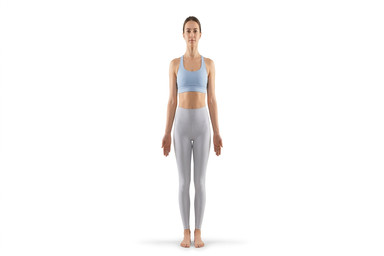
How to
A standing posture that trains tall alignment, steady balance, and calm breathing.
- Stand with your feet together or hip-width apart.
- Press evenly through both feet and lift through the crown of your head.
- Let your arms rest by your sides with palms facing forward.
- Hold the posture and breathe slowly.
- Relax your shoulders and release when done.
- Stand tall, not stiff
- Keep your weight even
- Locking your knees hard
- Letting your ribs flare forward
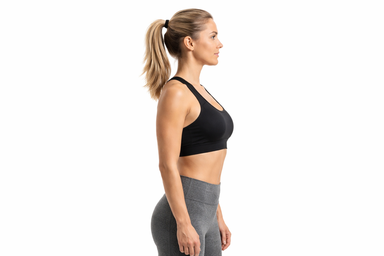
How to
A simple shoulder mobility move that warms up your upper back, neck, and shoulders.
- Stand tall with your arms relaxed at your sides.
- Lift both shoulders up toward your ears.
- Roll them back and down in a smooth circle.
- Repeat for reps, then reverse the direction if needed.
- Move slowly and smoothly.
- Keep your neck relaxed.
- Shrugging with tension in your neck.
- Rushing through small, jerky circles.
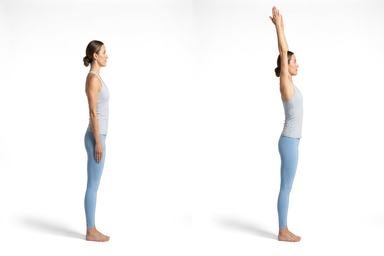
How to
A standing reach that opens your chest and shoulders while warming up your spine.
- Stand tall with feet hip-width and arms by your sides.
- Inhale and sweep both arms out and overhead.
- Reach up through your fingertips and lift your chest slightly.
- Exhale and lower your arms back to your sides.
- Repeat with smooth, controlled breaths.
- Keep your ribs down
- Reach tall, not back
- Arching hard through your lower back
- Shrugging your shoulders toward your ears
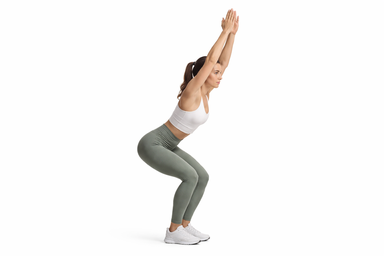
How to
A standing squat-like hold that trains your thighs, glutes, and core.
- Stand tall with feet together or hip-width apart.
- Bend your knees and send your hips back like sitting in a chair.
- Raise your arms overhead or keep hands at your chest.
- Hold the position and breathe steadily.
- Press through your feet to stand back up.
- Keep your chest lifted.
- Keep knees tracking over toes.
- Letting your knees collapse inward.
- Arching your lower back as you hold.
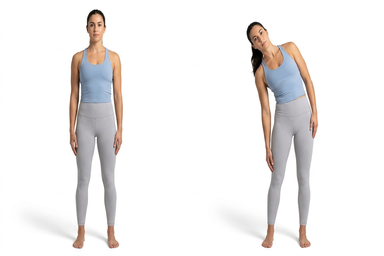
How to
A standing trunk bend that trains your side abs and helps you control side-to-side motion.
- Stand tall with feet hip-width apart and knees soft.
- Place your hands behind your head or at your sides.
- Brace your abs and bend your torso to one side.
- Return to center with control.
- Repeat to the other side and continue side to side.
- Keep your chest open
- Move slowly and stay tall
- Leaning forward or twisting as you bend
- Letting your hips shift far to the side
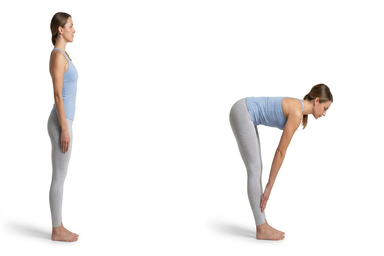
How to
A standing hip-hinge hold that lengthens your hamstrings and trains a long, flat back.
- Stand with feet hip-width and soften your knees.
- Hinge at your hips and fold halfway forward.
- Rest your hands on your thighs, shins, or blocks.
- Lengthen your spine and reach the crown of your head forward.
- Hold the position and breathe steadily.
- Keep your back long
- Press evenly through both feet
- Rounding your back to reach lower
- Locking your knees
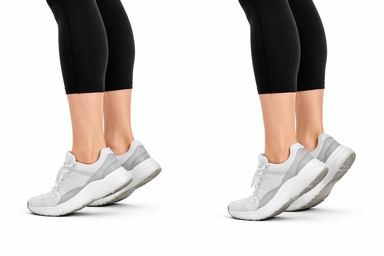
How to
A standing lower-leg move that trains your calves by lifting and lowering your heels.
- Stand tall with feet hip-width apart and toes pointing forward.
- Press through the balls of your feet and lift your heels high.
- Pause briefly at the top without leaning forward.
- Lower your heels with control to the floor.
- Keep your knees softly straight.
- Rise straight up, not forward.
- Bouncing through the reps.
- Letting your ankles roll outward.
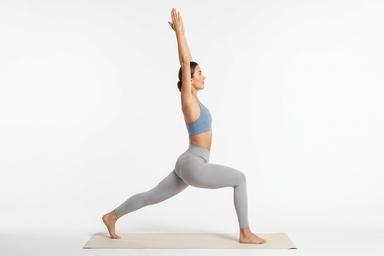
How to
A standing yoga lunge hold that trains your legs, hips, and upright posture.
- Stand tall, then step one foot back into a long stance.
- Turn your back foot out slightly and bend your front knee.
- Square your hips forward and reach both arms overhead.
- Hold the pose and breathe slowly.
- Lower your arms and step your back foot forward to stand.
- Keep your front knee over your ankle.
- Press both feet into the floor.
- Letting your front knee cave inward.
- Arching your lower back to reach higher.
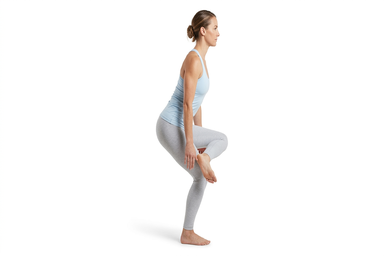
How to
A standing hip stretch that targets your glutes and outer hip while challenging balance.
- Stand tall and hold a wall or chair for balance if needed.
- Cross one ankle over the opposite thigh, making a figure four.
- Bend your standing knee and sit your hips back until you feel a stretch.
- Hold the position and breathe slowly.
- Release with control, then switch legs.
- Keep your chest lifted
- Flex the crossed foot
- Rounding your back as you sit back
- Forcing the knee down with your hand
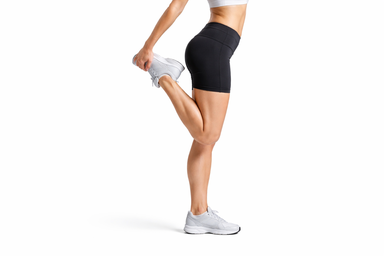
How to
A standing thigh stretch that targets the front of your hip and quad on one leg.
- Stand tall and hold a wall or chair for balance if needed.
- Bend one knee and hold your ankle or foot behind you.
- Keep your knees close and gently draw your heel toward your glute.
- Hold the stretch and breathe slowly.
- Release with control, then switch legs.
- Stand tall through your chest
- Keep your knees close
- Arching your lower back
- Pulling the knee out to the side

Standing Chain: From Base to Crown
Mountain pose anchors the kinetic chain by activating intrinsic foot muscles and posterior tibialis, creating the postural baseline that every subsequent movement references. Chair pose then loads the glutes and thoracic extensors under mild isometric tension, reinforcing the same alignment pattern with added neuromuscular demand.

Recovery Without the Floor Tax
Standing-only flows eliminate the ground-transition cost that makes traditional yoga inaccessible during fatigue, injury, or stiffness. The Figure Four stretch targets the piriformis and external hip rotators in a load-bearing position, which actually improves proprioceptive feedback compared to supine versions — a meaningful edge for desk workers and those with lower back sensitivity.

Ten Minutes, Real Neural Reset
This sequence follows a deliberate arousal arc: mobility priming via shoulder rolls, eccentric hip loading in Warriors I, then parasympathetic downshift through the forward fold and quad stretch. To personalize, extend your hold on whichever pose reveals asymmetry — that side's stabilizers are your limiting factor for both posture and injury resilience.