
Clean & Minimal AI Powered Fitness Routines
Download AppIntermediate Achilles Tendinopathy Routine
A progressive, tendon-friendly calf loading session to reduce pain and build capacity in ~25 minutes.
Intermediate Achilles Tendinopathy Routine
A progressive, tendon-friendly calf loading session to reduce pain and build capacity in ~25 minutes.
Warm-Up
Increase blood flow and gently mobilize the ankle before loading. Duration: 5 minutes.
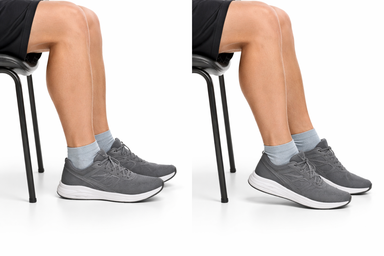
How to
A simple ankle movement that warms your calves and shins and moves both ankles through flex and point.
- Sit or lie down with both legs extended and relaxed.
- Pull your toes toward your shins on both feet.
- Point your toes away from you on both feet.
- Move smoothly back and forth for the set.
- Keep your knees still
- Use a full, smooth range
- Bouncing or jerking the ankles
- Letting your legs tense up
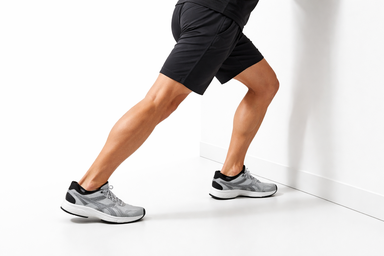
How to
A standing calf stretch that targets the back of your lower leg with a steady hold.
- Stand facing a wall and place your hands on it.
- Step one foot back and keep that heel on the floor.
- Bend your front knee until you feel a calf stretch.
- Hold and breathe slowly without bouncing.
- Finish the hold, then switch legs.
- Keep your back heel down
- Point both toes forward
- Bouncing in the stretch
- Letting the back heel lift
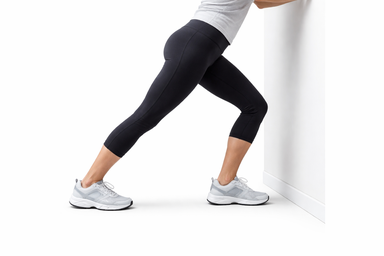
How to
A bent-knee calf stretch that targets the soleus in your lower calf.
- Stand facing a wall with one foot back and hands on the wall.
- Bend both knees and keep your back heel on the floor.
- Lean forward until you feel a stretch in your lower calf.
- Hold the stretch and breathe steadily.
- Finish the hold, then switch legs.
- Keep your back heel down
- Keep your toes pointing forward
- Letting the back heel lift
- Turning the back foot outward
Circuit A
Isometric and eccentric work. Use a step if tolerated. For eccentrics: rise with both legs, lower on one leg for 3–4 seconds.
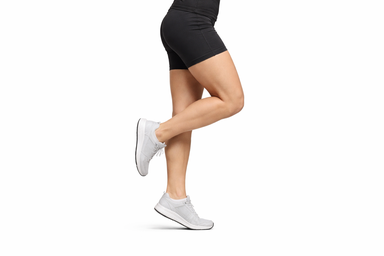
How to
A single-leg calf raise hold that trains your calf and ankle control.
- Stand on one leg with your toes facing forward.
- Rise onto the ball of your foot and lift your heel high.
- Hold the top position and breathe steadily.
- Lower with control when the hold is done.
- Finish your hold, then switch legs.
- Keep your knee softly bent.
- Stay tall through your body.
- Letting your ankle roll outward or inward.
- Bouncing instead of holding still.
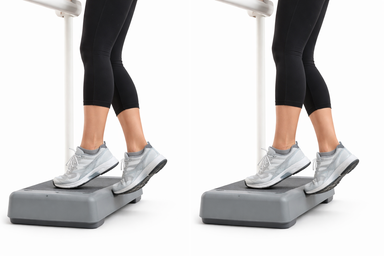
How to
A slow heel-lowering move that trains your calf and ankle control on one leg.
- Stand on a step with one forefoot on the edge and hold support.
- Rise to the top, using both feet if needed.
- Shift weight to one foot and slowly lower that heel below the step.
- Place the other foot down and return to the top.
- Finish your reps, then switch legs.
- Lower with control
- Keep your knee tracking forward
- Dropping quickly at the bottom
- Letting your ankle roll in or out
Circuit B
Soleus bias and foot control. Keep knee slightly bent for bent-knee raises. Move slow and controlled.
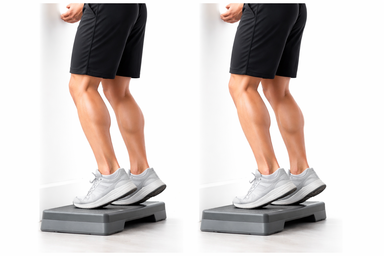
How to
A calf raise with bent knees that trains your calves, especially the deeper calf muscles.
- Stand tall with feet hip-width apart and knees softly bent.
- Keep your knees bent as you lift your heels off the floor.
- Rise onto the balls of your feet and pause briefly.
- Lower your heels with control back to the floor.
- Repeat for all reps.
- Keep knees bent the whole time.
- Press through the balls of your feet.
- Straightening your knees as you lift.
- Rocking forward instead of lifting straight up.
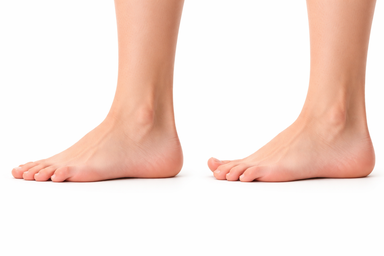
How to
A foot control drill that trains your toe muscles and arch awareness.
- Stand or sit with both feet flat and toes pointing forward.
- Lift both big toes while keeping the other toes down.
- Lower your big toes, then lift the four small toes on each foot.
- Move slowly and keep the balls of your feet on the floor.
- Repeat, alternating big toes and small toes with control.
- Keep your arches gently lifted
- Move only your toes
- Letting your feet roll in or out
- Clawing the toes instead of lifting them
Cool-Down
Downshift and restore comfortable range without pushing into pain. Duration: 3 minutes.
How to
A standing calf stretch that targets the back of your lower leg with a steady hold.
- Stand facing a wall and place your hands on it.
- Step one foot back and keep that heel on the floor.
- Bend your front knee until you feel a calf stretch.
- Hold and breathe slowly without bouncing.
- Finish the hold, then switch legs.
- Keep your back heel down
- Point both toes forward
- Bouncing in the stretch
- Letting the back heel lift
How to
A bent-knee calf stretch that targets the soleus in your lower calf.
- Stand facing a wall with one foot back and hands on the wall.
- Bend both knees and keep your back heel on the floor.
- Lean forward until you feel a stretch in your lower calf.
- Hold the stretch and breathe steadily.
- Finish the hold, then switch legs.
- Keep your back heel down
- Keep your toes pointing forward
- Letting the back heel lift
- Turning the back foot outward

Eccentric Loading & Isometric Pain Control
The Single-Leg Isometric Hold exploits tendon pain-inhibition to calm reactive tissue before the Eccentric Heel Drop introduces the slow, high-load lengthening that drives collagen remodeling in the Achilles. Bent-Knee Calf Raises then isolate the soleus — the deeper, often-overlooked culprit in mid-portion tendinopathy.

Why Achilles Tendons Hate Passive Rest
Tendinopathic tissue loses its load-bearing capacity through disuse faster than any other connective tissue, making graded mechanical stress the actual treatment. The progression from ankle pumps to single-leg loading mirrors how the Achilles must manage 6–8x bodyweight during running — rebuilding that tolerance incrementally is the entire game.

Structure Your Progression Around Pain Response
Rate your pain on a 0–10 scale during Eccentric Heel Drops — a 3–4 is acceptable, above 5 means reduce range or load. As morning stiffness and post-session soreness diminish over 4–6 weeks, add tempo (slower eccentrics) before adding reps, honoring the tendon's slower adaptation timeline compared to muscle.