
Clean & Minimal AI Powered Fitness Routines
Download AppIntermediate Shin Splints Relief and Strength
A ~25-minute low-impact routine to reduce shin splints irritation and build calf/tibialis/foot strength.
Intermediate Shin Splints Relief and Strength
A ~25-minute low-impact routine to reduce shin splints irritation and build calf/tibialis/foot strength.
Warm-Up and Mobility
Increase blood flow and gently mobilize ankles and feet without impact. Duration: 5 minutes.
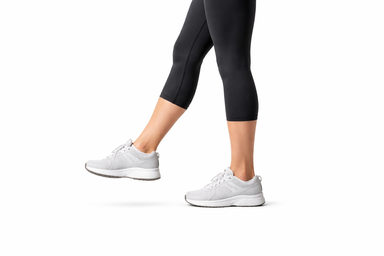
How to
A simple ankle mobility move that warms up your ankle through a full circle.
- Sit or stand tall and lift one foot slightly off the floor.
- Slowly circle your ankle in one direction.
- Reverse the circle and keep the motion smooth.
- Finish your reps, then switch legs.
- Move from your ankle, not your knee
- Keep the circles slow and controlled
- Rushing through small, choppy circles
- Letting your whole leg swing around
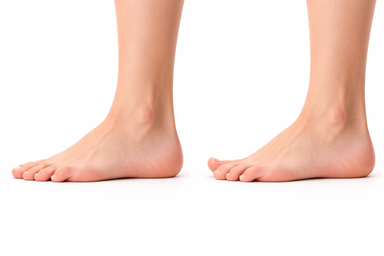
How to
A foot control drill that trains your toe muscles and arch awareness.
- Stand or sit with both feet flat and toes pointing forward.
- Lift both big toes while keeping the other toes down.
- Lower your big toes, then lift the four small toes on each foot.
- Move slowly and keep the balls of your feet on the floor.
- Repeat, alternating big toes and small toes with control.
- Keep your arches gently lifted
- Move only your toes
- Letting your feet roll in or out
- Clawing the toes instead of lifting them
Tibialis and Calf Combo
Tibialis anterior and calf work combined. Use controlled tempo. On calf raises: 2 seconds up, 2 seconds down.
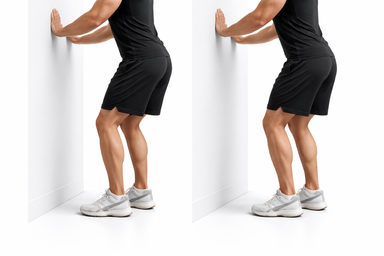
How to
A wall-supported toe raise that trains the muscles along the front of your shins.
- Stand with your back against a wall and feet hip-width apart.
- Keep your heels on the floor and legs mostly straight.
- Lift your toes toward your shins as high as you can.
- Lower your toes back to the floor with control.
- Repeat for your reps.
- Keep your heels planted.
- Move only at your ankles.
- Letting your heels lift off the floor.
- Rocking your hips away from the wall.
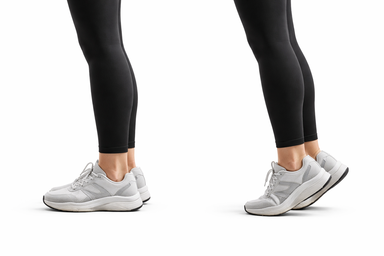
How to
A standing lower-leg move that trains your calves by lifting and lowering your heels.
- Stand tall with both feet hip-width apart.
- Press through the balls of your feet and lift your heels.
- Pause briefly at the top with control.
- Lower your heels slowly back to the floor.
- Repeat for your reps.
- Keep your ankles tracking straight.
- Move up and down with control.
- Rocking onto the outside edges of your feet.
- Bouncing at the bottom of each rep.
Eccentric Calf Focus
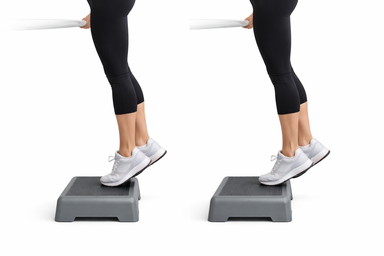
Lower slowly (3–4 seconds). Use support as needed. If too intense, do both legs together.
How to
A slow single-leg calf lower off a step that trains your calves with focus on control.
- Stand on the ball of one foot on a step, heel off the edge.
- Hold a rail or wall for balance.
- Lift to the top, using your other foot for help if needed.
- Slowly lower that heel below the step for 3 to 5 seconds.
- Use both feet to return to the top.
- Finish your reps, then switch legs.
- Lower with control
- Keep your knee tracking over your toes
- Dropping quickly at the bottom
- Letting your ankle roll in or out
Balance and Tibialis Endurance
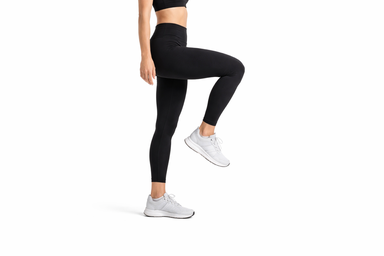
Stay tall, tripod foot (big toe, little toe, heel). Use a chair for light support if needed.
How to
A one-leg standing hold that trains balance and stability in your foot, ankle, and hips.
- Stand tall with feet hip-width apart and arms relaxed.
- Shift your weight onto one foot and lift the other foot off the floor.
- Hold steady, keep your torso tall, and breathe slowly.
- Lower your foot with control, then switch legs.
- Keep your hips level
- Look at one spot ahead
- Letting your hips twist or drop
- Holding your breath
How to
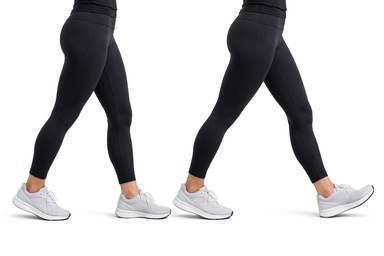
A walking drill on your heels that trains the muscles along your shins and challenges ankle control.
- Stand tall with feet hip-width apart.
- Lift your toes so only your heels touch the floor.
- Walk forward with small, controlled steps on your heels.
- Keep your toes pulled up as you move.
- Finish the distance, then lower your feet to stand.
- Stay tall through your torso.
- Keep your toes lifted.
- Letting your toes drop to the floor.
- Taking long, sloppy steps.
Cool-Down and Stretch
Downshift and gently stretch calves and soleus to finish. Duration: 4 minutes.
How to
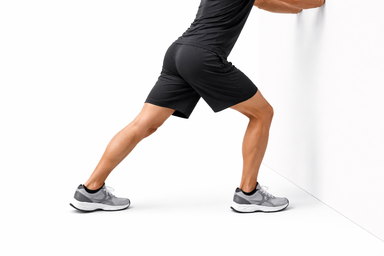
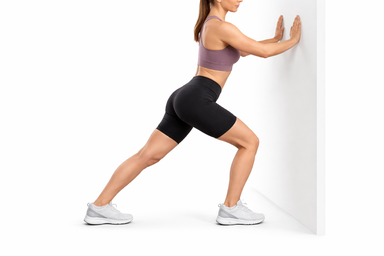
A wall-supported calf stretch that targets the back of your lower leg on one side at a time.
- Stand facing a wall and place both hands on it.
- Step one foot back, keeping that heel down and toes forward.
- Bend your front knee until you feel a stretch in the back calf.
- Hold the stretch and breathe slowly.
- Release, then switch legs.
- Keep your back heel down
- Point both feet forward
- Letting the back heel lift
- Turning the back foot out
How to
A wall calf stretch with a bent knee that targets your soleus.
- Face a wall and place both hands on it.
- Step one foot back and bend both knees.
- Keep the back heel down and lean in.
- Hold and breathe, then switch sides.
- Keep your back heel flat
- Bend the back knee
- Lifting the back heel
- Letting the back knee cave inward

Eccentric Loading Targets Tendon Remodeling
The Eccentric Calf Lower off a step places controlled tensile stress on the Achilles and tibialis anterior tendons during the lengthening phase — the exact stimulus that drives collagen synthesis and tendon stiffening. Paired with Wall Tibialis Raises, this routine directly addresses the anterior compartment weakness that underlies most shin splint presentations.

Shin Splints Is a Bone-Load Management Problem
Medial tibial stress syndrome isn't just muscle tightness — it's cumulative periosteal overload from repetitive impact without adequate tissue capacity. The progression from Ankle Circles through Heel Walk mirrors exactly how load must be reintroduced: joint mobility first, then isolated strength, then gait-pattern stress under bodyweight.

Soleus vs. Gastrocnemius: Why Both Stretches Exist
The straight-leg Wall Calf Stretch targets the two-joint gastrocnemius, while the bent-knee Soleus Stretch isolates the deeper, single-joint soleus — a distinction most routines miss entirely. Alternate Single-Leg Balance holds with small ankle perturbations to accelerate proprioceptive adaptation and reduce your re-injury risk on uneven surfaces.