
Clean & Minimal AI Powered Fitness Routines
Download AppTRX Functional Strength Builder
TRX push + pull + legs + core for muscle gain, posture, and balance while staying low-back friendly.
TRX Functional Strength Builder
TRX push + pull + legs + core for muscle gain, posture, and balance while staying low-back friendly.
Warm-Up
Prep shoulders, hips, and core bracing for rows, presses, split squats, and hamstring curls.
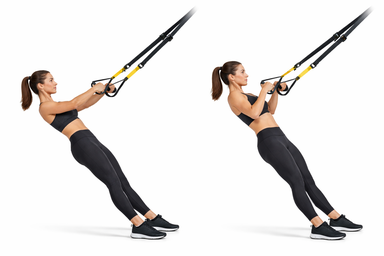
How to
A suspension strap row that trains your back, shoulders, and arms using your body weight.
- Hold the straps and lean back with arms straight, body in a line.
- Set your feet so the angle feels challenging but controlled.
- Pull your chest toward the handles, elbows close to your sides.
- Lower with control until your arms are straight again.
- Keep your body in a straight line.
- Squeeze your shoulder blades back.
- Letting your hips sag or pike.
- Shrugging your shoulders toward your ears.
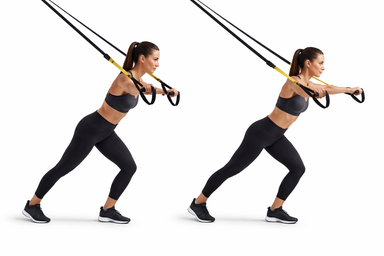
How to
A standing press using suspension straps that trains your chest, shoulders, and triceps.
- Face away from the anchor and hold a handle in each hand at chest height.
- Step back and lean forward with your body in a straight line.
- Bend your elbows and lower your chest between your hands.
- Press the handles away until your arms are straight.
- Repeat for all reps, keeping steady control.
- Keep your body in one straight line.
- Brace your core as you press.
- Letting your hips sag or pike.
- Flaring your elbows straight out.
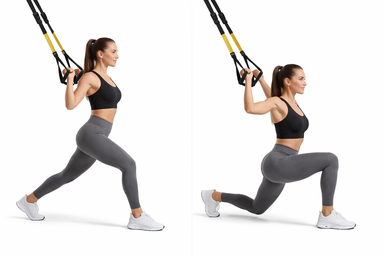
How to
A rear-foot suspended split squat that trains your quads, glutes, and balance.
- Stand tall with one foot in the suspension strap behind you.
- Hop the front foot forward until you feel steady.
- Bend the front knee and lower your back knee toward the floor.
- Drive through the front foot to stand back up.
- Finish your reps, then switch legs.
- Keep your chest tall
- Track your front knee over your toes
- Leaning too far forward as you lower
- Letting the front knee cave inward
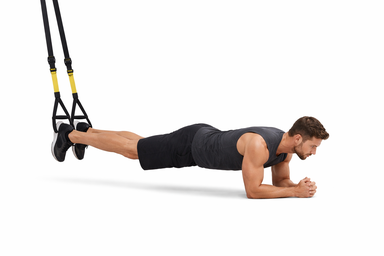
How to
A suspension strap plank that trains your core, shoulders, and glutes while you hold a straight body line.
- Set your feet in the straps and place your hands under your shoulders.
- Step or slide back until your body forms a straight line.
- Brace your abs and squeeze your glutes.
- Hold the plank and breathe steadily.
- Lower your knees or step forward to come out of the hold.
- Keep ribs down and hips level.
- Push the floor away.
- Letting your hips sag or pike up.
- Shrugging your shoulders toward your ears.
Circuit A
Use a challenging but clean angle. Aim for 2–4 seconds on the lowering phase for rows and presses.
How to
A suspension strap row that trains your back, shoulders, and arms using your body weight.
- Hold the straps and lean back with arms straight, body in a line.
- Set your feet so the angle feels challenging but controlled.
- Pull your chest toward the handles, elbows close to your sides.
- Lower with control until your arms are straight again.
- Keep your body in a straight line.
- Squeeze your shoulder blades back.
- Letting your hips sag or pike.
- Shrugging your shoulders toward your ears.
How to
A standing press using suspension straps that trains your chest, shoulders, and triceps.
- Face away from the anchor and hold a handle in each hand at chest height.
- Step back and lean forward with your body in a straight line.
- Bend your elbows and lower your chest between your hands.
- Press the handles away until your arms are straight.
- Repeat for all reps, keeping steady control.
- Keep your body in one straight line.
- Brace your core as you press.
- Letting your hips sag or pike.
- Flaring your elbows straight out.
How to
A rear-foot suspended split squat that trains your quads, glutes, and balance.
- Stand tall with one foot in the suspension strap behind you.
- Hop the front foot forward until you feel steady.
- Bend the front knee and lower your back knee toward the floor.
- Drive through the front foot to stand back up.
- Finish your reps, then switch legs.
- Keep your chest tall
- Track your front knee over your toes
- Leaning too far forward as you lower
- Letting the front knee cave inward
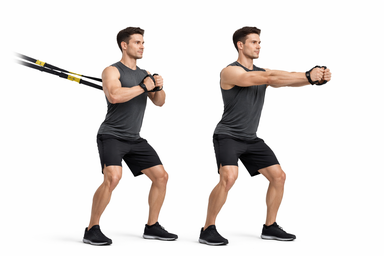
How to
A standing anti-rotation press with suspension straps that trains your core, shoulders, and hips.
- Stand sideways to the anchor and hold the handles at your chest.
- Step out until the straps are tight and brace your core.
- Press the handles straight forward without letting your torso turn.
- Bring the handles back to your chest with control.
- Finish your reps, then switch sides.
- Keep your hips and shoulders square.
- Move only your arms.
- Letting the straps pull your torso toward the anchor.
- Arching your back as you press.
Circuit B
Posterior chain + posture. Keep hips level on hamstring curls; stop before low-back takes over.
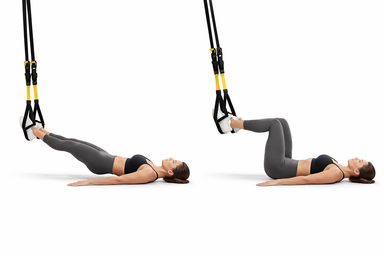
How to
A suspension strap leg curl that trains your hamstrings and glutes from a bridge position.
- Lie on your back with both heels in the straps and legs straight.
- Lift your hips into a straight line from shoulders to knees.
- Pull both heels toward your hips while keeping your hips up.
- Slowly straighten your legs to return to the start.
- Keep your hips lifted
- Move with control
- Letting your hips sag during the curl
- Arching your lower back at the top
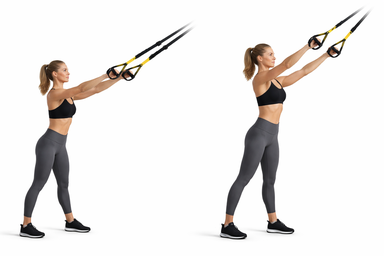
How to
A suspension strap fly that trains your upper back and shoulders in a Y shape.
- Hold the handles and lean back with arms straight in front of you.
- Keep your body in a straight line from head to heels.
- Pull your arms up and out into a Y as you lift your chest.
- Pause briefly with shoulders down and ribs tucked.
- Lower with control to the start position.
- Keep your shoulders down
- Move your body as one unit
- Shrugging your shoulders toward your ears
- Arching your lower back as you pull
How to
A suspension strap plank that trains your core, shoulders, and glutes while you hold a straight body line.
- Set your feet in the straps and place your hands under your shoulders.
- Step or slide back until your body forms a straight line.
- Brace your abs and squeeze your glutes.
- Hold the plank and breathe steadily.
- Lower your knees or step forward to come out of the hold.
- Keep ribs down and hips level.
- Push the floor away.
- Letting your hips sag or pike up.
- Shrugging your shoulders toward your ears.

Suspension Vectors Target Deep Stabilizers
The TRX Row and Y Fly load the mid and lower trapezius through scapular retraction and upward rotation — the exact muscles that counteract desk-posture collapse. Meanwhile, the Split Squat and Hamstring Curl demand hip stability under load, recruiting glute medius and semimembranosus that machines simply bypass.

Low-Back Safety Without Sacrificing Intensity
Suspension training shifts spinal loading by keeping the lumbar in neutral through constant anti-extension demand — the Plank and Pallof Press reinforce this by training rotational and sagittal stiffness simultaneously. You get genuine muscle stimulus without compressive axial load that aggravates posterior chain sensitivity.

Instability as Your Progressive Overload Tool
Increasing foot-to-anchor distance on the Chest Press or elevating the rear foot on the Split Squat are your primary intensity levers here — small adjustments that shift mechanical disadvantage and force greater motor unit recruitment. Apply the principle of specificity by prioritizing whichever push-pull ratio addresses your weakest postural chain first.