
Clean & Minimal AI Powered Fitness Routines
Download AppIntermediate Rotator Cuff Shoulder Pain Relief
A shoulder-friendly rotator cuff and scapular stability session to reduce pain and build resilient strength in ~25 minutes.
Intermediate Rotator Cuff Shoulder Pain Relief
A shoulder-friendly rotator cuff and scapular stability session to reduce pain and build resilient strength in ~25 minutes.
Warm-Up & Pain-Calming
Gentle motion to reduce stiffness and prepare the shoulder for strengthening.
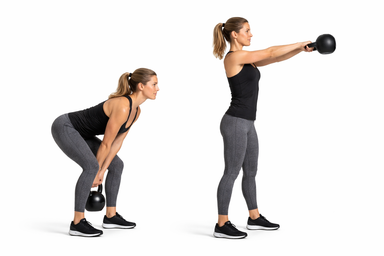
How to
A dynamic leg swing that warms up your hips and trains balance as you alternate sides.
- Stand tall with light support if needed.
- Brace your core and lift one foot slightly off the floor.
- Swing the leg forward and back like a pendulum.
- Set it down, then repeat with the other leg.
- Keep alternating sides with smooth control.
- Stand tall through your chest
- Move from your hip, not your lower back
- Swinging so high your torso leans back
- Rushing the switch between legs
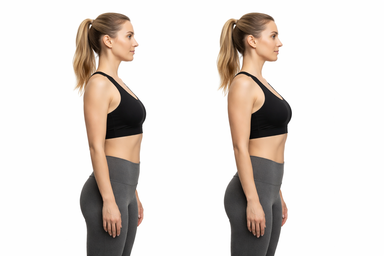
How to
A small shoulder blade squeeze that trains your upper back and shoulder control.
- Stand or sit tall with your arms relaxed by your sides.
- Pull your shoulder blades back and slightly down.
- Pause briefly while keeping your ribs stacked.
- Release with control to the start position.
- Repeat for the set.
- Keep your neck relaxed
- Move from your shoulder blades
- Shrugging your shoulders toward your ears
- Arching your lower back to create the squeeze
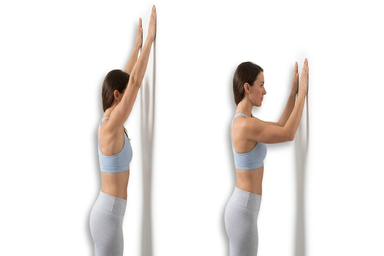
How to
A wall-based shoulder move that trains shoulder control and upper-back posture.
- Stand with your back to a wall and feet a small step out.
- Press your head, upper back, and hips gently into the wall.
- Place your arms on the wall in a goalpost shape.
- Slide your arms up the wall as far as you can control.
- Slide back down to the start and repeat.
- Keep your ribs down.
- Move slowly and stay in control.
- Arching your lower back to reach higher.
- Shrugging your shoulders toward your ears.
Circuit A
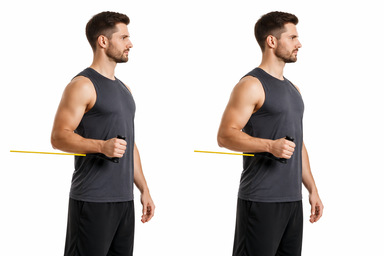
Moderate tension band. Elbow stays close to side on rotations.
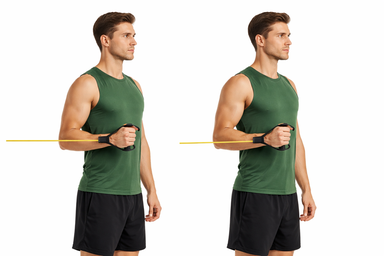
How to
A one-arm band rotation that trains your shoulder rotators.
- Stand tall with the band at your side and elbow bent 90 degrees.
- Keep your elbow tucked to your side.
- Rotate your forearm outward against the band.
- Slowly return to start under control.
- Finish your reps, then switch sides.
- Keep your elbow pinned to your side
- Move only your forearm
- Letting your elbow drift away from your body
- Twisting your torso to cheat the rep
How to
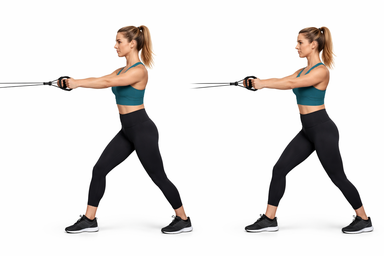
A one-arm band rotation that trains your shoulder rotators and control.
- Anchor the band at elbow height and stand sideways.
- Bend your elbow to 90 degrees and keep it tucked in.
- Rotate your forearm inward, then return with control.
- Finish your reps, then switch sides.
- Keep your elbow pinned to your side
- Move slowly and stay upright
- Letting your elbow drift away from your body
- Using momentum instead of control
How to
A standing pull that trains your back, shoulders, and arms.
- Stand tall and hold the band at chest height.
- Brace your core and pull your elbows back.
- Squeeze your shoulder blades together.
- Slowly return with control and repeat.
- Keep your chest up
- Pull with your elbows
- Shrugging your shoulders up
- Leaning back to cheat the pull
Circuit B
Keep wrists neutral and shoulder blades moving smoothly. No shrugging.
How to
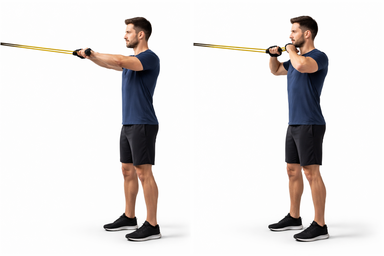
A band pull to your face that trains your upper back, rear shoulders, and shoulder control.
- Anchor the band at face height and hold one end in each hand.
- Step back with arms straight and palms facing down or in.
- Pull the band toward your face, leading with your elbows.
- Squeeze your shoulder blades, then slowly extend your arms.
- Repeat for all reps with steady control.
- Keep your ribs down
- Pull elbows high and wide
- Shrugging your shoulders toward your ears
- Leaning back to move the band
How to
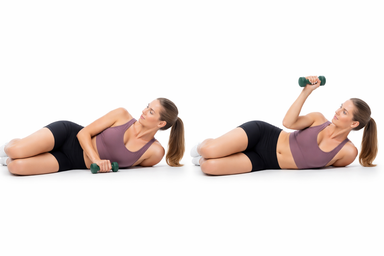
A side-lying shoulder rotation that trains your rotator cuff and upper back control.
- Lie on one side with your working elbow bent 90 degrees at your ribs.
- Keep your wrist straight and rotate your forearm up toward the ceiling.
- Pause briefly at the top without rolling your body back.
- Lower with control to the start position.
- Finish your reps, then switch sides.
- Keep your elbow pinned to your side.
- Move slow and stay stacked.
- Rolling your torso back to lift higher.
- Letting your elbow drift away from your ribs.
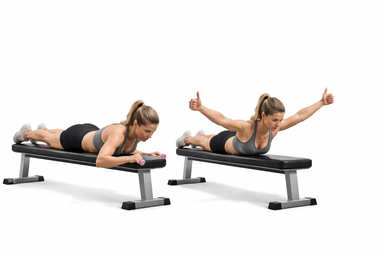
How to
A face-down shoulder raise that trains your upper back and rear shoulders.
- Lie face down with legs long and arms overhead in a Y.
- Set your thumbs up and keep your forehead near the floor.
- Lift your arms a few inches, then lower with control.
- Move your arms out to a T and repeat the lift.
- Continue alternating Y raises and T raises for your reps.
- Squeeze your shoulder blades gently
- Keep your neck long
- Shrugging your shoulders toward your ears
- Lifting your chest high off the floor
Cool-Down
Gentle stretching to reduce post-session tightness.
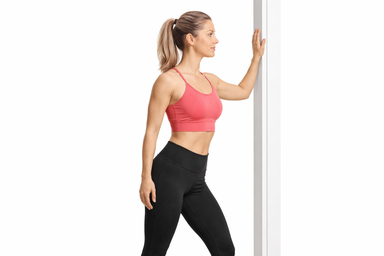
How to
A doorway chest stretch that opens your pecs and front shoulders.
- Stand in a doorway and place one forearm on the frame.
- Step one foot through and gently turn your body away.
- Hold the stretch and breathe slowly.
- Finish your reps, then switch sides.
- Keep your shoulder down
- Breathe into the stretch
- Forcing the stretch too hard
- Shrugging your shoulder up

Infraspinatus, Teres Minor & the Force Couple
Band external rotation and side-lying external rotation directly load infraspinatus and teres minor — the two muscles most responsible for centering the humeral head during overhead motion. Pairing these with face pulls and prone Y/T raises trains the lower trapezius and serratus anterior to anchor the scapula, restoring the force couple that pain and disuse typically disrupt.

Why Rotator Cuff Pain Is a Stability Problem
Shoulder pain rarely originates from a single weak muscle — it emerges when the scapula loses its stable base, forcing the supraspinatus and biceps tendon to absorb loads they weren't built for. The pendulum swing exploits gravity to decompress the glenohumeral joint before any loading begins, which is why pain-calming comes first, not last.

Load Before Stretch, Always
Placing the doorway pec stretch at the end — not the beginning — is intentional: tight pectorals anteriorly tilt the scapula, but stretching them before the rotator cuff is activated just creates laxity without control. Progress this routine by increasing band resistance only when external rotation reps feel controlled through the full arc, not just at end range.