
Clean & Minimal AI Powered Fitness Routines
Download AppIntermediate Post-Stroke Gait Recovery
A focused gait, balance, and lower-body control session to support safer walking after stroke.
Intermediate Post-Stroke Gait Recovery
A focused gait, balance, and lower-body control session to support safer walking after stroke.
Warm-Up Flow
Keep effort light; hold support if needed.
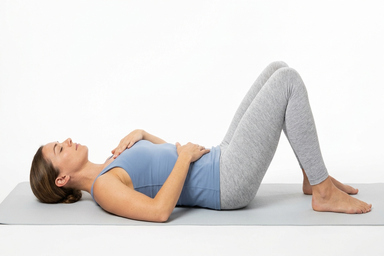
How to
A slow breathing drill that trains relaxed belly breathing and helps you control your breath.
- Lie on your back or sit tall with one hand on your belly.
- Inhale through your nose and let your belly rise.
- Exhale slowly and let your belly fall.
- Keep your chest and shoulders quiet.
- Continue for the set time with smooth breaths.
- Breathe low into your belly
- Keep your shoulders relaxed
- Shrugging your shoulders as you inhale
- Forcing the breath or holding tension
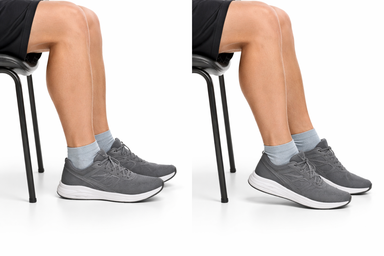
How to
A simple ankle movement that warms your calves and shins and moves both ankles through flex and point.
- Sit or lie down with both legs extended and relaxed.
- Pull your toes toward your shins on both feet.
- Point your toes away from you on both feet.
- Move smoothly back and forth for the set.
- Keep your knees still
- Use a full, smooth range
- Bouncing or jerking the ankles
- Letting your legs tense up
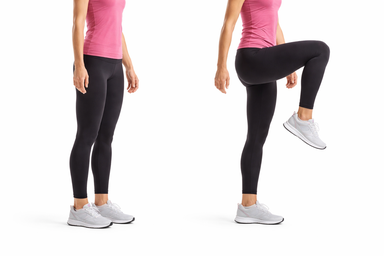
How to
A low-impact cardio move that warms up your legs and hips while raising your heart rate.
- Stand tall with your feet hip-width apart and arms at your sides.
- Lift one knee to hip height as you swing the opposite arm forward.
- Lower that foot, then lift the other knee and switch arms.
- Keep alternating sides at a steady pace.
- Slow down and plant both feet to finish.
- Stand tall with your chest up
- Land softly under your hips
- Leaning back as you lift your knees
- Stomping your feet on each step
Weight Shift Primer
Shift smoothly without hip hiking; keep knees soft.
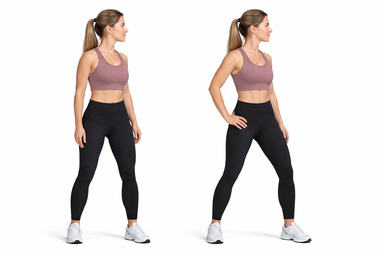
How to
A simple balance drill that shifts your weight from foot to foot to train control and stability.
- Stand tall with your feet hip-width apart.
- Shift your weight slowly onto one foot.
- Let the other foot get light, but keep it near the floor.
- Shift back through center and repeat to the other side.
- Move slowly and stay tall.
- Keep your hips level.
- Leaning your chest far to the side.
- Rushing the shift or losing control.
Supported Strength Circuit
Use a chair/counter. Move with control; pause if form degrades.
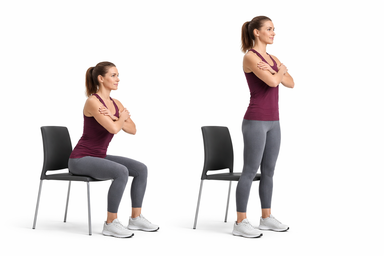
How to
A chair-based squat pattern that trains your thighs and glutes for standing strength.
- Sit near the front of a chair with feet flat and hip-width apart.
- Lean slightly forward and brace your core.
- Press through both feet and stand tall.
- Push your hips back and sit down with control.
- Keep your knees tracking over your toes
- Stand tall at the top
- Letting your knees cave inward
- Dropping hard onto the chair

How to
A lower-leg move that lifts your toes to train the muscles along the front of your shins.
- Stand tall with both feet hip-width apart and heels on the floor.
- Lift your toes and the balls of your feet as high as you can.
- Pause briefly at the top without leaning back.
- Lower your feet with control and repeat.
- Keep your heels planted
- Move with control
- Rocking your body back to lift higher
- Letting your knees cave in
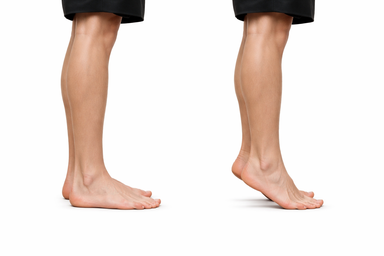
How to
A standing calf raise that trains your calves using bodyweight or added load.
- Stand tall with feet hip-width apart and toes pointing forward.
- Press through the balls of your feet and lift your heels high.
- Pause briefly at the top with control.
- Lower your heels slowly back to the floor.
- Keep your knees softly straight.
- Rise straight up, not forward.
- Bouncing through the reps.
- Letting your ankles roll outward or inward.
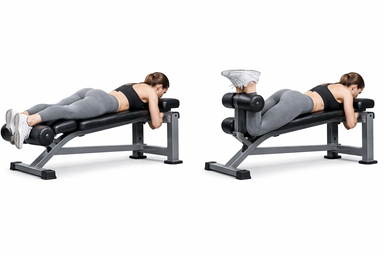
How to
A leg curl that trains your hamstrings by bending both knees against resistance.
- Lie face down with both legs straight and the pad just above your heels.
- Grip the handles and brace your core.
- Curl both heels toward your glutes without lifting your hips.
- Pause briefly, then lower with control to straight legs.
- Keep your hips down.
- Move slowly both ways.
- Lifting your hips to curl the weight.
- Letting the weight drop on the way down.
Hip Stability
Keep pelvis level; avoid leaning. Light hand support is OK.
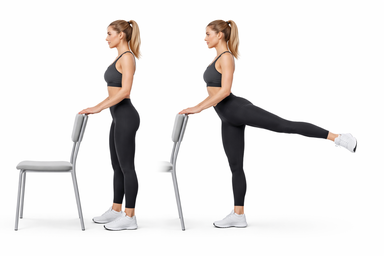
How to
A standing leg raise to the side that trains your outer hips and balance.
- Stand tall with one hand on a wall or chair for balance.
- Shift your weight onto one leg and brace your core.
- Lift the other leg out to the side without leaning your torso.
- Lower the leg with control to the start position.
- Finish your reps, then switch legs.
- Keep your toes facing forward.
- Stand tall through each rep.
- Leaning your torso to lift the leg.
- Turning your toes outward as you raise.
Step Accuracy & Balance
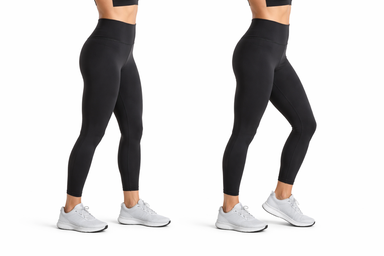
Tap a target (imaginary line/tile edge). Stand tall; slow and precise.
How to
A low-impact cardio move that trains coordination and gets your legs moving side to side.
- Stand tall with feet hip-width apart and arms relaxed.
- Step one foot to the side and tap the other foot in next to it.
- Step back the other way and tap the opposite foot in.
- Keep alternating sides at a steady pace.
- Slow down and return to standing when finished.
- Stay light on your feet
- Keep your chest up
- Leaning forward as you tap
- Letting your knees cave inward
How to
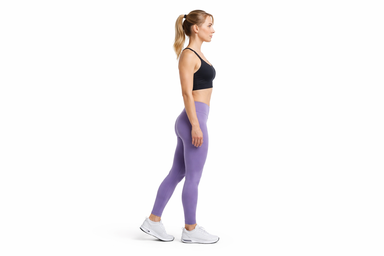
A narrow heel-to-toe balance hold that trains steady posture and control.
- Stand tall near support if needed.
- Place one foot directly in front of the other, heel to toe.
- Keep your weight even and eyes forward.
- Hold the stance and breathe slowly.
- Stand tall through your head
- Keep your feet in one line
- Leaning your body to one side
- Looking down the whole time
Focused Walking
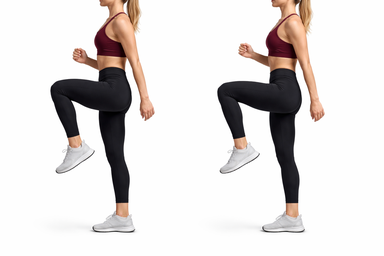
Walk with deliberate heel strike, quiet steps, and even arm swing if safe.
How to
A controlled walking pattern that warms up your legs and trains posture, balance, and coordination.
- Stand tall with your feet hip-width apart.
- Step forward with one foot and swing the opposite arm.
- Roll from heel to toe as you walk.
- Keep a steady rhythm for the set distance or time.
- Stand tall with eyes forward
- Use relaxed arm swings
- Looking down the whole time
- Shuffling instead of taking controlled steps

Rebuilding the Gait Cycle from the Ground Up
Ankle pumps and heel/toe raises directly retrain the tibialis anterior and gastrocnemius-soleus complex — the muscles responsible for foot clearance and push-off, the two most commonly disrupted phases of gait post-stroke. Sit-to-stand builds the eccentric quad control needed to transition safely from sit to ambulation, while hip abduction and hamstring curls restore the lateral stability and swin

How Stroke Rewires the Walking Equation
Post-stroke hemiparesis doesn't just weaken muscles — it disrupts the neural timing between muscle groups, making coordinated reciprocal movement like walking genuinely effortful. Spasticity, reduced proprioception, and asymmetric weight-bearing create a feedback loop where the unaffected side overcompensates, reinforcing imbalance with every step. The supported exercises here deliberately load th

Neuroplasticity Responds to Repetition and Intent
This session is structured around the principle of task-specific training — step taps, tandem stance, and the focused walking drill aren't just balance work, they're repetitive motor pattern rehearsal that drives cortical remapping. Weight shifts and marching prime the central pattern generators before full gait practice, reducing fall risk while maximizing neural stimulus. To personalize, reduce