
Clean & Minimal AI Powered Fitness Routines
Download AppIntermediate Chronic Ankle Instability
A ~25-minute ankle stability routine focused on balance, calf strength, and controlled range of motion.
Intermediate Chronic Ankle Instability
A ~25-minute ankle stability routine focused on balance, calf strength, and controlled range of motion.
Warm-Up
Gently warm the ankle and foot, then start light activation. — Mobility and activation work.
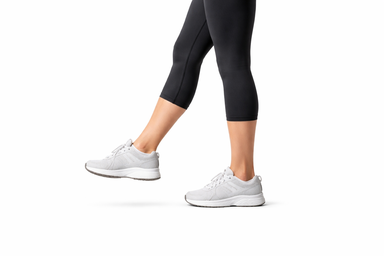
How to
A simple ankle mobility move that warms up your ankle through a full circle.
- Sit or stand tall and lift one foot slightly off the floor.
- Slowly circle your ankle in one direction.
- Reverse the circle and keep the motion smooth.
- Finish your reps, then switch legs.
- Move from your ankle, not your knee
- Keep the circles slow and controlled
- Rushing through small, choppy circles
- Letting your whole leg swing around
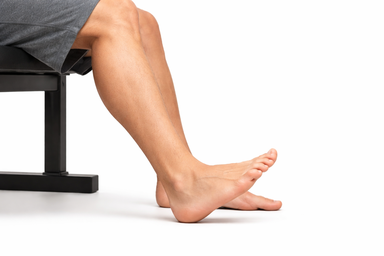
How to
A simple ankle mobility drill where you trace letters with your foot to move the ankle in many directions.
- Sit tall or lie down with one leg extended.
- Lift one foot slightly off the floor.
- Use your big toe to trace the alphabet in the air.
- Move from the ankle, not from your whole leg.
- Finish the alphabet, then switch sides.
- Keep the movement slow and controlled.
- Make each letter as large as you can.
- Swinging your whole leg to draw the letters.
- Rushing through the alphabet.
Strength
Build ankle strength in all directions and improve calf capacity. — Band work and calf exercises.
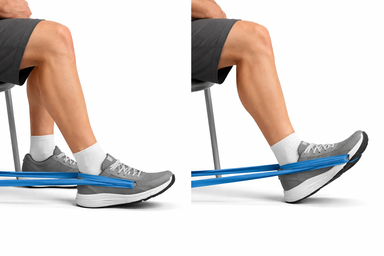
How to
A band-resisted ankle move that trains the muscles that lift your foot and control your ankle.
- Sit with one leg straight and loop a band over the top of one foot.
- Anchor the band in front of your toes so it pulls your foot away.
- Pull your toes toward your shin against the band.
- Slowly point your foot back to the start.
- Finish your reps, then switch sides.
- Move only at the ankle.
- Control the band both ways.
- Letting the knee or hip twist.
- Snapping the foot back too fast.
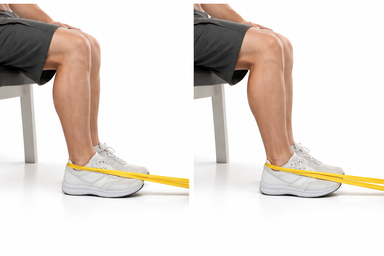
How to
A banded ankle press that trains your calves through plantarflexion.
- Sit with one leg out and loop the band around your forefoot.
- Hold the band ends and start with your toes pulled back.
- Point your foot down against the band, then control it back.
- Finish your reps, then switch ankles.
- Move through the ankle only
- Keep the band under steady tension
- Using your whole leg instead of just your foot
- Letting the band snap back too fast
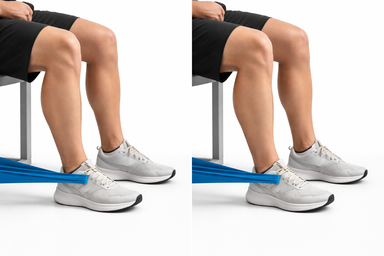
How to
A band ankle move that trains your inner lower leg and ankle control.
- Sit and loop the band around one foot, anchored to the outside.
- Start with your foot neutral and your leg still.
- Turn your foot inward against the band.
- Slowly return to neutral.
- Finish your reps, then switch sides.
- Keep your shin still
- Move only at the ankle
- Twisting your whole leg
- Using a fast, jerky motion
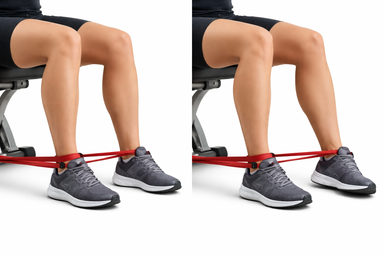
How to
A band-resisted ankle move that trains the outer lower leg and ankle control.
- Sit with one leg extended and loop a band around the forefoot.
- Anchor the band so it pulls your foot inward.
- Turn your foot outward against the band, keeping your leg still.
- Slowly return to the start with control.
- Finish your reps, then switch sides.
- Move only at the ankle.
- Keep the motion slow and controlled.
- Letting your knee or hip rotate.
- Snapping the foot back to the start.
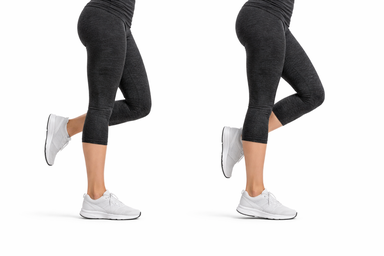
How to
A one-leg calf raise that trains your calves and balance.
- Stand tall on one foot near a wall or support.
- Let your heel drop slightly if standing on a step.
- Press through the ball of your foot and lift your heel high.
- Lower with control until your heel is down or slightly below the step.
- Finish your reps, then switch legs.
- Keep your knee mostly straight.
- Move straight up and down.
- Bouncing at the bottom.
- Rolling your ankle in or out.
Balance and Control
Improve stability and control under balance challenge and light functional loading. — Proprioception work.

How to
A one-leg standing hold that trains balance and stability in your foot, ankle, and hips.
- Stand tall with feet hip-width apart and arms relaxed.
- Shift your weight onto one foot and lift the other foot off the floor.
- Hold steady, keep your torso tall, and breathe slowly.
- Lower your foot with control, then switch legs.
- Keep your hips level
- Look at one spot ahead
- Letting your hips twist or drop
- Holding your breath
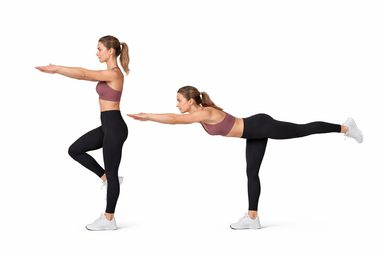
How to
A single-leg balance move where you reach away from your stance leg. It trains control, balance, and hip stability.
- Stand tall on one leg with a soft bend in your knee.
- Reach your free foot or hand forward, side, or back with control.
- Keep your weight over the middle of your standing foot.
- Return to tall standing without rushing.
- Finish your reps, then switch legs.
- Keep your hips level.
- Move slow and stay controlled.
- Letting your knee cave inward.
- Tapping down hard between reaches.

How to
A one-leg hip hinge that trains your hamstrings and glutes while challenging balance.
- Stand tall on one leg with a soft bend in your knee.
- Hinge at your hips and send your free leg back behind you.
- Lower your torso until you feel a stretch in your standing leg.
- Drive through your standing foot to return to tall.
- Finish your reps, then switch legs.
- Keep your hips square.
- Keep your back long.
- Rounding your back as you lower.
- Opening your hips toward the side.
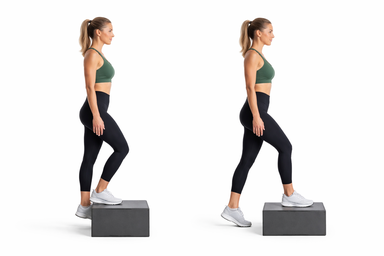
How to
A controlled step from a raised surface that trains your quads, glutes, and balance.
- Stand on a step with one foot near the edge.
- Let the other foot hover off the front of the step.
- Bend your standing knee and lower your free heel toward the floor.
- Tap lightly, then press through your standing foot to return to the top.
- Finish your reps, then switch legs.
- Keep your knee tracking over your toes.
- Move slowly and stay tall.
- Dropping your free foot hard to the floor.
- Letting your standing knee cave inward.

Targeting the Lateral Ligament Complex
Band eversion and single-leg balance reach directly load the peroneals — the muscles most responsible for resisting inversion sprains. Ankle alphabet and circles restore synovial fluid distribution across the talocrural joint before any load is applied, reducing re-injury risk during the strength work that follows.

Why CAI Keeps Coming Back
Chronic ankle instability isn't just ligament laxity — it's a neuromuscular deficit where mechanoreceptors in the lateral ligament complex stop firing accurately. The step down and single-leg RDL exploit perturbation-based loading to retrain proprioceptive feedback loops that standard strengthening alone never addresses.

Sensorimotor Sequencing Is the Strategy
This routine follows a mobility-to-stability-to-dynamic-load progression, which matches how the nervous system needs to be primed before proprioceptive training sticks. Increase the single-leg balance reach distance weekly as a simple progressive overload marker — when you can touch 90% of your leg length in all directions, advance to eyes-closed variations.