
Clean & Minimal AI Powered Fitness Routines
Download AppTRX Functional Strength Builder
TRX push + pull + legs + core for muscle gain, posture, and balance while staying low-back friendly.
TRX Functional Strength Builder
TRX push + pull + legs + core for muscle gain, posture, and balance while staying low-back friendly.
Warm-Up
Prep shoulders, hips, and core bracing for rows, presses, split squats, and hamstring curls.
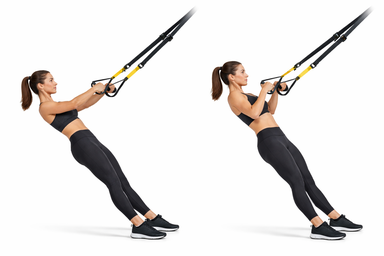
How to
A suspension strap row that trains your back, shoulders, and arms using your body weight.
- Hold the straps and lean back with arms straight, body in a line.
- Set your feet so the angle feels challenging but controlled.
- Pull your chest toward the handles, elbows close to your sides.
- Lower with control until your arms are straight again.
- Keep your body in a straight line.
- Squeeze your shoulder blades back.
- Letting your hips sag or pike.
- Shrugging your shoulders toward your ears.
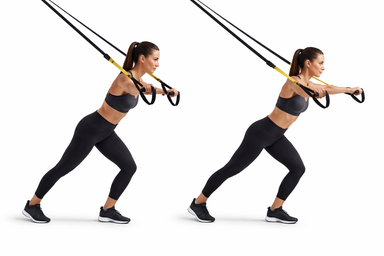
How to
A standing press using suspension straps that trains your chest, shoulders, and triceps.
- Face away from the anchor and hold a handle in each hand at chest height.
- Step back and lean forward with your body in a straight line.
- Bend your elbows and lower your chest between your hands.
- Press the handles away until your arms are straight.
- Repeat for all reps, keeping steady control.
- Keep your body in one straight line.
- Brace your core as you press.
- Letting your hips sag or pike.
- Flaring your elbows straight out.
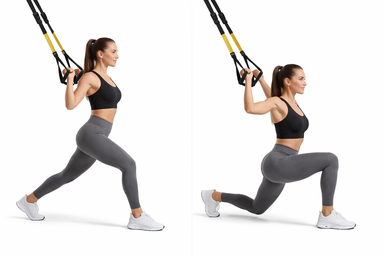
How to
A rear-foot suspended split squat that trains your quads, glutes, and balance.
- Stand tall with one foot in the suspension strap behind you.
- Hop the front foot forward until you feel steady.
- Bend the front knee and lower your back knee toward the floor.
- Drive through the front foot to stand back up.
- Finish your reps, then switch legs.
- Keep your chest tall
- Track your front knee over your toes
- Leaning too far forward as you lower
- Letting the front knee cave inward
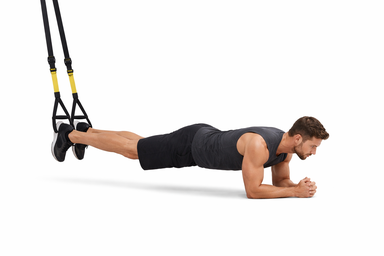
How to
A suspension strap plank that trains your core, shoulders, and glutes while you hold a straight body line.
- Set your feet in the straps and place your hands under your shoulders.
- Step or slide back until your body forms a straight line.
- Brace your abs and squeeze your glutes.
- Hold the plank and breathe steadily.
- Lower your knees or step forward to come out of the hold.
- Keep ribs down and hips level.
- Push the floor away.
- Letting your hips sag or pike up.
- Shrugging your shoulders toward your ears.
Circuit A
Use a challenging but clean angle. Aim for 2–4 seconds on the lowering phase for rows and presses.
How to
A suspension strap row that trains your back, shoulders, and arms using your body weight.
- Hold the straps and lean back with arms straight, body in a line.
- Set your feet so the angle feels challenging but controlled.
- Pull your chest toward the handles, elbows close to your sides.
- Lower with control until your arms are straight again.
- Keep your body in a straight line.
- Squeeze your shoulder blades back.
- Letting your hips sag or pike.
- Shrugging your shoulders toward your ears.
How to
A standing press using suspension straps that trains your chest, shoulders, and triceps.
- Face away from the anchor and hold a handle in each hand at chest height.
- Step back and lean forward with your body in a straight line.
- Bend your elbows and lower your chest between your hands.
- Press the handles away until your arms are straight.
- Repeat for all reps, keeping steady control.
- Keep your body in one straight line.
- Brace your core as you press.
- Letting your hips sag or pike.
- Flaring your elbows straight out.
How to
A rear-foot suspended split squat that trains your quads, glutes, and balance.
- Stand tall with one foot in the suspension strap behind you.
- Hop the front foot forward until you feel steady.
- Bend the front knee and lower your back knee toward the floor.
- Drive through the front foot to stand back up.
- Finish your reps, then switch legs.
- Keep your chest tall
- Track your front knee over your toes
- Leaning too far forward as you lower
- Letting the front knee cave inward
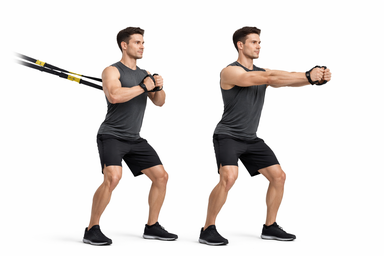
How to
A standing anti-rotation press with suspension straps that trains your core, shoulders, and hips.
- Stand sideways to the anchor and hold the handles at your chest.
- Step out until the straps are tight and brace your core.
- Press the handles straight forward without letting your torso turn.
- Bring the handles back to your chest with control.
- Finish your reps, then switch sides.
- Keep your hips and shoulders square.
- Move only your arms.
- Letting the straps pull your torso toward the anchor.
- Arching your back as you press.
Circuit B
Posterior chain + posture. Keep hips level on hamstring curls; stop before low-back takes over.
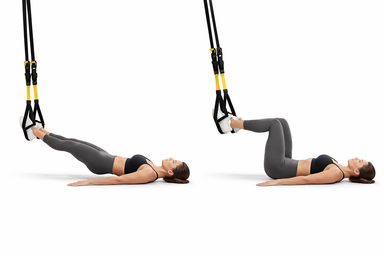
How to
A suspension strap leg curl that trains your hamstrings and glutes from a bridge position.
- Lie on your back with both heels in the straps and legs straight.
- Lift your hips into a straight line from shoulders to knees.
- Pull both heels toward your hips while keeping your hips up.
- Slowly straighten your legs to return to the start.
- Keep your hips lifted
- Move with control
- Letting your hips sag during the curl
- Arching your lower back at the top
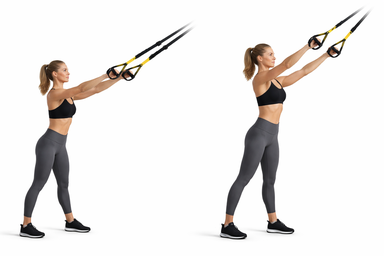
How to
A suspension strap fly that trains your upper back and shoulders in a Y shape.
- Hold the handles and lean back with arms straight in front of you.
- Keep your body in a straight line from head to heels.
- Pull your arms up and out into a Y as you lift your chest.
- Pause briefly with shoulders down and ribs tucked.
- Lower with control to the start position.
- Keep your shoulders down
- Move your body as one unit
- Shrugging your shoulders toward your ears
- Arching your lower back as you pull
How to
A suspension strap plank that trains your core, shoulders, and glutes while you hold a straight body line.
- Set your feet in the straps and place your hands under your shoulders.
- Step or slide back until your body forms a straight line.
- Brace your abs and squeeze your glutes.
- Hold the plank and breathe steadily.
- Lower your knees or step forward to come out of the hold.
- Keep ribs down and hips level.
- Push the floor away.
- Letting your hips sag or pike up.
- Shrugging your shoulders toward your ears.

Suspension Vectors Target Deep Stabilizers
The TRX Row and Y Fly load the posterior chain through scapular retraction and upward rotation, directly countering the forward-flexed posture that compression-based exercises reinforce. The instability vector forces your rotator cuff and mid-traps to co-contract on every rep, building structural integrity that barbells simply can't replicate.

Low-Back Friendly Doesn't Mean Low-Demand
Suspension training decouples spinal loading from muscular challenge — the Split Squat and Hamstring Curl generate serious quad and posterior chain stimulus without axial compression on lumbar discs. This makes TRX uniquely effective for those managing low-back sensitivity while still pursuing meaningful hypertrophy and movement quality.

Anti-Rotation Before Flexion: The Core Logic
Sequencing the Pallof Press before the TRX Plank trains your obliques and transverse abdominis to resist force first, then sustain it — mirroring how your core actually functions in athletic movement. Adjust your body angle on every pressing and rowing movement; a 5-10° change in foot position shifts relative load by 15-20%, giving you built-in progressive overload without adding a single piece of