
Clean & Minimal AI Powered Fitness Routines
Download AppEpic Squat Time
A squat-focused, time-based lower-body session with intervals for strength and burn.
Epic Squat Time
A squat-focused, time-based lower-body session with intervals for strength and burn.
Warm-Up
Prime hips, knees, and ankles for squat volume. 5 minutes.
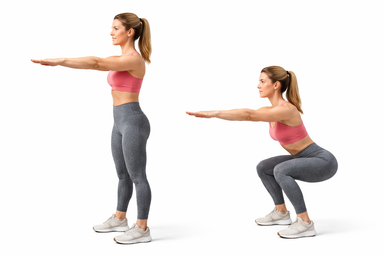
How to
A bodyweight squat that trains your quads, glutes, and core.
- Stand with feet about shoulder-width apart.
- Brace your core and push your hips back.
- Bend your knees and lower until thighs are near parallel.
- Drive through your whole foot to stand tall.
- Keep your chest up
- Knees track over toes
- Heels lifting off the floor
- Knees collapsing inward
Main Squat Intervals
Timed squat variations to build strength endurance and leg burn. 18 minutes.
How to
A bodyweight squat that trains your quads, glutes, and core.
- Stand with feet about shoulder-width apart.
- Brace your core and push your hips back.
- Bend your knees and lower until thighs are near parallel.
- Drive through your whole foot to stand tall.
- Keep your chest up
- Knees track over toes
- Heels lifting off the floor
- Knees collapsing inward
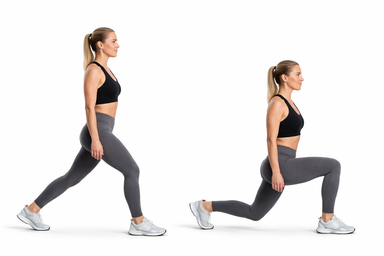
How to
A staggered-stance squat that trains your quads, glutes, and balance one leg at a time.
- Stand in a long split stance with your front foot flat.
- Keep your chest tall and bend both knees to lower down.
- Lower until your front thigh is near parallel, if comfortable.
- Press through your front foot to stand back up.
- Finish your reps, then switch legs.
- Keep your front knee tracking over your toes.
- Stay tall through your torso.
- Letting your front heel lift off the floor.
- Pushing your front knee far inward.
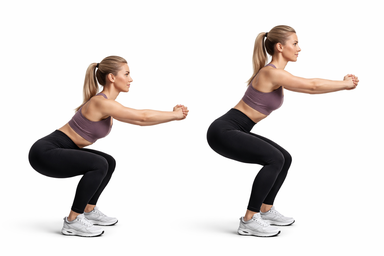
How to
A small-range squat variation that keeps tension on your quads, glutes, and hips.
- Stand with feet about shoulder-width apart and toes slightly out.
- Lower into a squat with your chest up and knees tracking over toes.
- Pulse a few inches up and down without fully standing.
- Finish your reps, then stand tall with control.
- Keep your chest lifted
- Stay low through each pulse
- Letting your knees cave in
- Bouncing fast or losing control
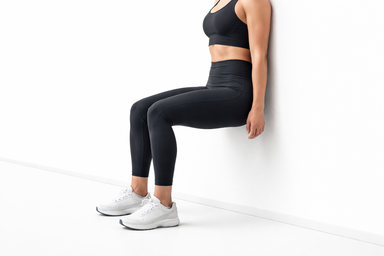
How to
An isometric squat hold against a wall that trains your quads, glutes, and endurance.
- Stand with your back against a wall and feet hip-width apart.
- Walk your feet forward and slide down until your thighs are near parallel.
- Keep your back on the wall and knees over your ankles.
- Hold the position and breathe steadily.
- Stand up by pressing through your feet when finished.
- Keep your chest tall
- Press your back into the wall
- Letting your knees cave inward
- Holding your breath
Finisher
Last push to empty the tank with controlled form. 2 minutes.
How to
A bodyweight squat that trains your quads, glutes, and core.
- Stand with feet about shoulder-width apart.
- Brace your core and push your hips back.
- Bend your knees and lower until thighs are near parallel.
- Drive through your whole foot to stand tall.
- Keep your chest up
- Knees track over toes
- Heels lifting off the floor
- Knees collapsing inward
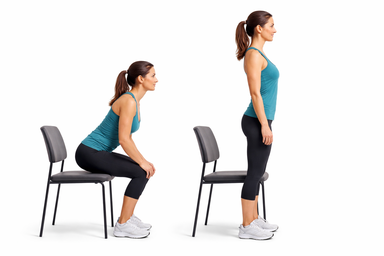
How to
A squat to a chair that trains your quads, glutes, and control through a comfortable range.
- Stand in front of a chair with feet about shoulder-width apart.
- Brace your core and reach your hips back.
- Bend your knees and lower until your hips tap the chair.
- Press through your feet to stand tall again.
- Repeat for your reps.
- Keep your chest lifted
- Track knees over toes
- Dropping hard onto the chair
- Letting your knees cave inward

Quad Dominance by Design
Air Squats and Split Squats load the rectus femoris and vastus lateralis through full range of motion, while Wall Sits create sustained isometric tension that recruits slow-twitch fibers conventional reps miss. Jump Squats then force fast-twitch recruitment, hitting both fiber types in a single session.

Why Squat Endurance Is Brutally Hard
The quadriceps are the largest muscle group in the body, demanding enormous oxygen delivery — which is why sustained squat work spikes heart rate faster than most upper-body training. Squat Pulses and Chair Squats exploit time-under-tension at your weakest joint angle, where fatigue compounds fastest.

Time-Based Intervals Over Rep Counts
Structuring work around duration rather than reps enforces consistent mechanical output regardless of fatigue, a principle called density training that builds both muscular endurance and metabolic conditioning simultaneously. To personalize intensity, adjust your squat depth during Pulses — shallower means more quad isolation, deeper shifts load into the glutes.