
Clean & Minimal AI Powered Fitness Routines
Download AppIntermediate Skateboarding Session
A ~25-minute intermediate skateboarding session focused on control, balance, and trick consistency.
Intermediate Skateboarding Session
A ~25-minute intermediate skateboarding session focused on control, balance, and trick consistency.
Warm-Up
Get blood flowing and dial in stance, pushing, and turning control. 5 minutes.
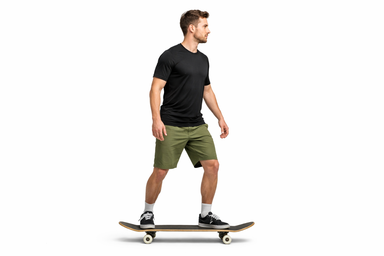
How to
A dynamic warm-up that mimics pushing a skateboard. It wakes up your hips, legs, and balance.
- Stand tall with feet hip-width apart and arms relaxed.
- Shift weight to one leg and sweep the other foot back like a push.
- Bring that foot back under you and stand tall.
- Repeat on the other side, alternating smoothly each rep.
- Keep your chest lifted
- Move with control
- Leaning too far forward
- Letting your knees cave inward
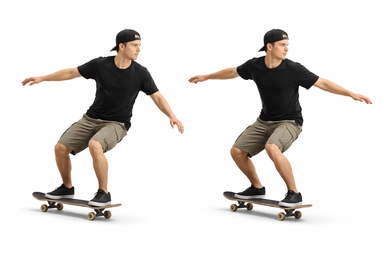
How to
A skateboard balance drill that uses side-to-side turns to train coordination, legs, and core control.
- Stand on the board on flat, clear ground with knees soft.
- Shift weight slightly to your back foot and lighten the front wheels.
- Twist your hips and shoulders to swing the nose to one side.
- Set the front wheels down, then swing the nose to the other side.
- Keep alternating sides with small, controlled tic-tacs.
- Keep your knees bent
- Turn with your hips and shoulders
- Leaning too far back
- Making big, rushed swings
Balance & Control Block
Alternate attempts with short resets. Keep shoulders quiet; use ankles/knees to correct balance.
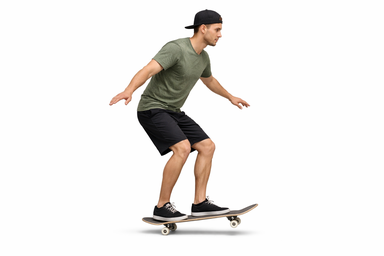
How to
A one-foot skateboard balance hold that trains control, calves, and core while lifting the front wheels.
- Stand on the board with one foot over the rear bolts.
- Brace your core and lift the front wheels slightly.
- Hold the balance point and breathe steadily.
- Finish your hold, lower with control, then switch legs.
- Keep your hips level.
- Keep your gaze forward.
- Leaning too far back.
- Jerking the board to lift the front wheels.
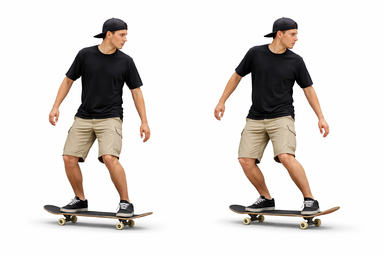
How to
A skateboard turn that lifts the front wheels and pivots the board. It trains balance, foot control, and core control.
- Stand on the board with your back foot on the tail and front foot near the front bolts.
- Bend your knees and shift more weight over the back foot.
- Press the tail lightly to lift the front wheels.
- Turn your shoulders and hips to pivot the board in small steps.
- Set the front wheels down with control and reset your stance.
- Finish your reps, then switch sides.
- Keep your knees soft.
- Look where you want to turn.
- Slamming the tail into the ground.
- Leaning back and losing control.
Trick Consistency Block
Aim for clean landings. If you miss, reset stance and try again—no rushing.
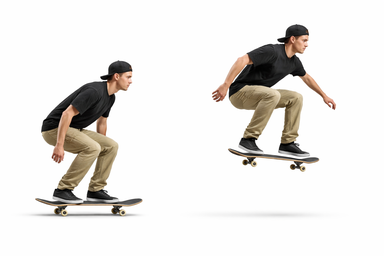
How to
A quick jump that mimics a skateboard pop, training legs, calves, and coordination.
- Stand with feet staggered, knees soft, and arms ready.
- Dip into your hips and knees to load the jump.
- Pop up fast, pull your knees up, and level your feet in the air.
- Land softly with knees bent and feet staggered.
- Reset and alternate your lead foot each rep.
- Land quietly with soft knees
- Keep your chest up
- Landing stiff-legged
- Letting your knees cave inward
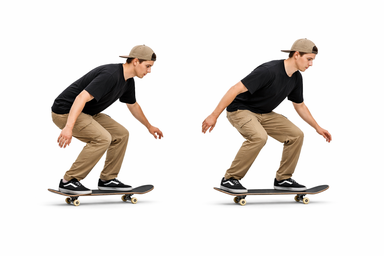
How to
A skateboard trick where you pop and spin the board 180 degrees under you, training timing, coordination, and control.
- Stand in your normal stance with your back foot on the tail.
- Bend your knees and keep your shoulders level over the board.
- Pop the tail down and scoop back to spin the board 180 degrees.
- Jump up, let the board rotate under you, then catch it with your feet.
- Land with bent knees and roll away balanced.
- Keep your shoulders over the board
- Jump up before you catch it
- Leaning too far forward or back
- Kicking the board away instead of scooping
Cool-Down
Lower intensity to finish, focusing on smooth rolling and relaxed posture. 2 minutes.
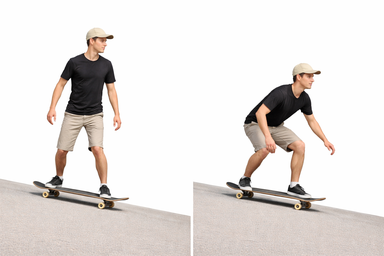
How to
A skateboard rollout that trains your abs, shoulders, and control through a smooth forward roll.
- Kneel with both hands on the skateboard under your shoulders.
- Brace your core and keep your hips in line with your ribs.
- Roll the board forward slowly as your body lowers.
- Pause before your back arches, then pull the board back to start.
- Repeat with control for all reps.
- Keep your ribs down.
- Move in a range you can control.
- Letting your lower back sag.
- Rolling farther than you can pull back.

Pop Mechanics & Proprioceptive Demand
Ollies and Pop Shove-Its require explosive ankle plantarflexion paired with rapid tibialis anterior activation to level the board mid-air. Manual Practice specifically trains single-leg proprioception and ankle stability under sustained load — the exact neuromuscular demand that separates consistent trick landings from bails.

Why Trick Consistency Is a Balance Problem
Skateboarding at the intermediate level is governed by your vestibular-proprioceptive feedback loop, not raw strength. Tic-Tacs and Kickturns train weight-shift timing and rotational control through the hip abductors and obliques — the muscles that quietly determine whether your pop shove-it lands bolts or sends you sliding out.

Density Over Duration in Skill Sessions
At 25 minutes, this session prioritizes neural encoding through focused repetition blocks rather than volume accumulation — the principle of specificity applied to motor learning. Progressive overload here means tightening landing consistency before adding trick complexity. One actionable cue: count clean landings, not attempts, to track real adaptation.