
Clean & Minimal AI Powered Fitness Routines
Download AppIntermediate Sailing Conditioning
A 25-minute sailing-focused session for hiking endurance, core stability, and shoulder resilience.
Intermediate Sailing Conditioning
A 25-minute sailing-focused session for hiking endurance, core stability, and shoulder resilience.
Warm-Up
Raise temperature and mobilize spine/hips/shoulders for hiking and trimming positions. Duration: 5 minutes.
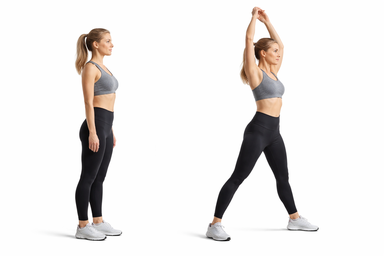
How to
A full-body cardio move that trains coordination, calves, shoulders, and hips.
- Stand tall with feet together and arms at your sides.
- Jump your feet out as you raise your arms overhead.
- Jump your feet back together as you lower your arms.
- Repeat at a steady pace, landing softly each time.
- Stay light on your toes
- Keep your chest tall
- Landing hard with locked knees
- Letting your arms swing out of control
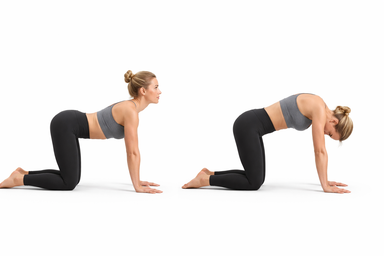
How to
A gentle spine mobility move that alternates rounding and arching your back on hands and knees.
- Start on hands and knees with wrists under shoulders and knees under hips.
- Inhale and drop your belly as you lift your chest and tailbone.
- Exhale and round your back, tucking your chin and tailbone.
- Move slowly between both positions with your breath.
- Move one vertebra at a time.
- Keep your shoulders away from your ears.
- Forcing your neck up or down.
- Rushing through the movement.
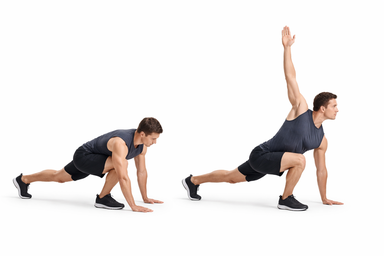
How to
A dynamic lunge stretch that opens your hips, hamstrings, and upper back as you alternate sides.
- Start in a high plank with hands under shoulders.
- Step your right foot outside your right hand.
- Drop your hips, then rotate your right arm up toward the ceiling.
- Place your hand down and step back to plank.
- Repeat on the left side, alternating sides each rep.
- Keep your front foot flat.
- Reach long through your top hand.
- Letting your front heel lift off the floor.
- Rushing the rotation without control.
Circuit A
Hike and core work. Maintain a braced trunk—think 'quiet torso' like holding a steady hiking angle.
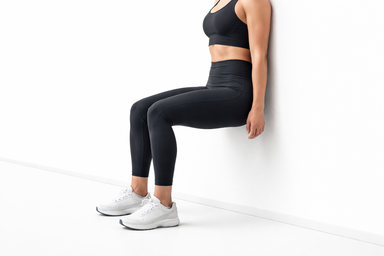
How to
An isometric squat hold against a wall that trains your quads, glutes, and endurance.
- Stand with your back against a wall and feet hip-width apart.
- Walk your feet forward and slide down until your thighs are near parallel.
- Keep your back on the wall and knees over your ankles.
- Hold the position and breathe steadily.
- Stand up by pressing through your feet when finished.
- Keep your chest tall
- Press your back into the wall
- Letting your knees cave inward
- Holding your breath
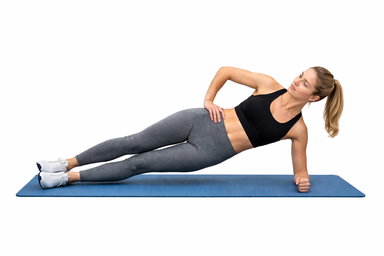
How to
A side hold that trains your obliques, hips, and shoulder stability.
- Lie on one side with your elbow under your shoulder and legs stacked.
- Lift your hips until your body forms a straight line.
- Hold the position and breathe steadily.
- Lower your hips with control.
- Finish your hold, then switch sides.
- Keep your hips stacked
- Press the floor away
- Letting your hips sag
- Rolling your chest toward the floor
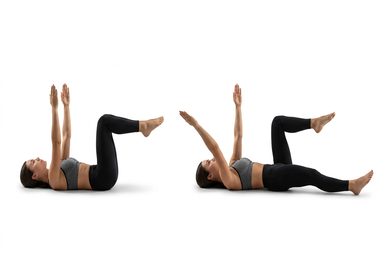
How to
A core move on your back that trains control while you move opposite arm and leg.
- Lie on your back with arms up and knees bent over hips.
- Press your lower back gently toward the floor.
- Lower one arm and the opposite leg with control.
- Return to the start, then repeat on the other side.
- Keep alternating sides for each rep.
- Move slow and stay braced
- Keep your ribs down
- Letting your lower back arch
- Rushing through the reps
Circuit B
Trim and shoulder work. Control the shoulder blades: pull elbows back on rows; keep elbow pinned on external rotations.
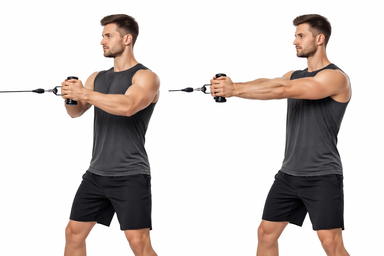
How to
An anti-rotation core hold that trains your abs and obliques to resist twisting.
- Stand sideways to an anchor with the handle at chest height.
- Hold it at your chest with both hands and step out to create tension.
- Brace your core and press your hands straight forward.
- Hold the position and breathe slowly without letting your torso turn.
- Bring your hands back to your chest with control.
- Keep your ribs down
- Stay tall and square
- Letting your torso rotate
- Shrugging your shoulders
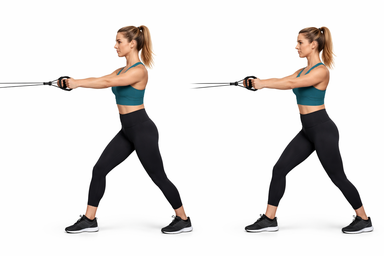
How to
A standing pull that trains your back, shoulders, and arms.
- Stand tall and hold the band at chest height.
- Brace your core and pull your elbows back.
- Squeeze your shoulder blades together.
- Slowly return with control and repeat.
- Keep your chest up
- Pull with your elbows
- Shrugging your shoulders up
- Leaning back to cheat the pull
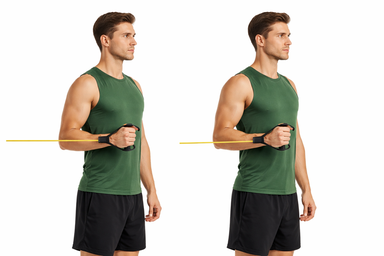
How to
A one-arm band rotation that trains your shoulder rotators.
- Stand tall with the band at your side and elbow bent 90 degrees.
- Keep your elbow tucked to your side.
- Rotate your forearm outward against the band.
- Slowly return to start under control.
- Finish your reps, then switch sides.
- Keep your elbow pinned to your side
- Move only your forearm
- Letting your elbow drift away from your body
- Twisting your torso to cheat the rep
Cool-Down
Downshift breathing and open hips/torso after hiking and bracing work. Duration: 2 minutes.
How to
A dynamic lunge stretch that opens your hips, hamstrings, and upper back as you alternate sides.
- Start in a high plank with hands under shoulders.
- Step your right foot outside your right hand.
- Drop your hips, then rotate your right arm up toward the ceiling.
- Place your hand down and step back to plank.
- Repeat on the left side, alternating sides each rep.
- Keep your front foot flat.
- Reach long through your top hand.
- Letting your front heel lift off the floor.
- Rushing the rotation without control.

Hiking Muscles & Rotator Cuff Logic
Wall sits target the quad-dominant isometric contraction sailors rely on during prolonged hiking, while band external rotation directly conditions the infraspinatus and teres minor against the repetitive overhead and sheeting loads that erode rotator cuff integrity over a season.

The Isometric Demand of Upwind Sailing
Hiking demands sustained eccentric quad loading and lumbar bracing for minutes at a time — not reps. The asymmetrical forces from tiller and mainsheet also create chronic rotational stress on the thoracic spine and shoulder girdle, making unilateral stability the real limiting factor in boat speed.

Anti-Rotation Before Rotation
The Pallof press and dead bug sequence builds stiffness through the anterior core before asking it to transfer force — a periodization principle called proximal stability before distal mobility. Progress wall sit duration by 5-second increments each session to systematically overload hiking-specific endurance without adding volume.