
Clean & Minimal AI Powered Fitness Routines
Download AppIntermediate Adductor Strength
A focused 25-minute session to strengthen the inner thighs (adductors) with controlled tempo and unilateral work.
Intermediate Adductor Strength
A focused 25-minute session to strengthen the inner thighs (adductors) with controlled tempo and unilateral work.
Warm-Up
Activate adductors and open hips before strength work. — Groin & Hip Prep
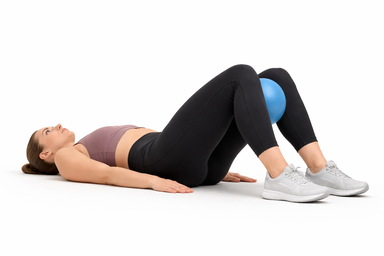
How to
A lying inner-thigh press against resistance that trains your hip adductors without joint movement.
- Lie on your back with knees bent and feet flat.
- Place your hand against the inside of one knee.
- Press that knee inward into your hand and hold.
- Breathe steadily and keep your pelvis still.
- Relax, finish your holds, then switch legs.
- Keep your pelvis level
- Press smoothly, not suddenly
- Letting your hip or pelvis roll
- Holding your breath during the hold
Circuit A
Move exercise-to-exercise with purpose. Rest briefly between rounds.

How to
A side lunge that trains your quads, glutes, and inner thighs while challenging control.
- Stand tall with feet hip-width apart and toes forward.
- Step one foot out to the side, keeping both feet flat.
- Bend the stepping knee and send your hips back.
- Push through the bent leg to return to standing.
- Finish your reps, then switch sides.
- Keep your chest lifted.
- Keep the straight leg long.
- Letting the bent knee cave inward.
- Rounding your back as you lower.
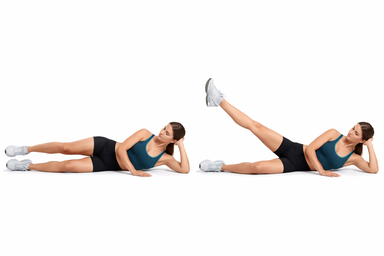
How to
A side-lying leg lift that trains your inner thigh on the lower leg.
- Lie on your side with your bottom leg straight.
- Bend your top knee and place that foot in front of your bottom leg.
- Brace your core and lift your bottom leg a few inches.
- Lower it with control without resting fully.
- Finish your reps, then switch sides.
- Keep your hips stacked.
- Move slowly and stay tall through your body.
- Rolling your hips backward as you lift.
- Swinging the leg instead of controlling it.
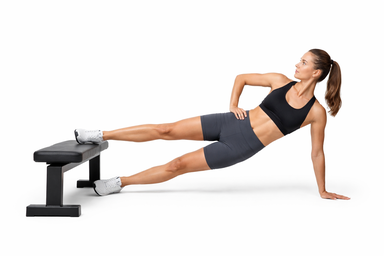
How to
A side plank with your top leg supported. It trains your inner thighs, hips, and core.
- Lie on your side with your forearm under your shoulder.
- Place your top foot or knee on a sturdy bench.
- Lift your hips and bring your bottom leg up toward the bench.
- Hold steady and breathe without letting your hips drop.
- Lower with control, then switch sides.
- Keep your body in a straight line.
- Press down through the top leg.
- Letting your hips sag or rotate.
- Shrugging your shoulder toward your ear.
Circuit B
Focus on alignment and smooth tempo; use a manageable weight.
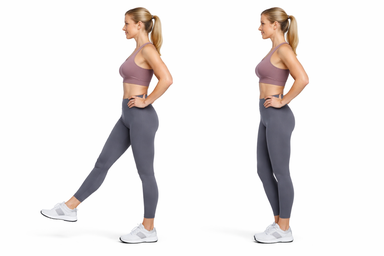
How to
A standing leg sweep that trains your inner thigh and hip control.
- Stand tall and hold a stable support if needed.
- Shift weight to one leg and lightly lift the other foot.
- Sweep the lifted leg across your body with control.
- Return it out to the side without swinging.
- Finish your reps, then switch legs.
- Keep your torso tall.
- Move from your hip, not your waist.
- Leaning your body to move the leg.
- Swinging with momentum.
Cool-Down
Downshift and restore length to the inner thighs.
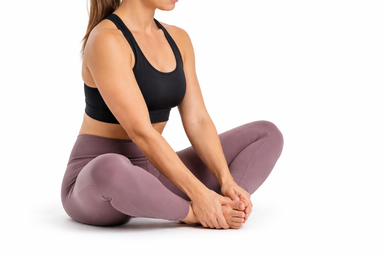
How to
A seated hip stretch that targets your inner thighs and groin.
- Sit tall and bring the soles of your feet together.
- Let your knees fall out to the sides.
- Hold your feet or ankles and lengthen through your spine.
- Relax your thighs and hold, breathing slowly.
- Keep your chest lifted
- Let your knees drop naturally
- Forcing your knees down with your hands
- Rounding your back to reach your feet

Isometrics Before Isotonics: A Smart Load Sequence
The supine isometric squeeze primes adductor magnus and longus under zero-velocity tension before heavier demands arrive — a proven method for improving motor unit recruitment. Copenhagen planks then challenge the adductors as hip stabilizers under full bodyweight, a load most isolation work never reaches.

Why Adductors Fail Under Lateral Force
The adductors aren't just pulling muscles — they decelerate hip abduction and control pelvic drop during single-leg loading. Lateral lunges in this routine expose exactly that vulnerability, forcing eccentric adductor control through a wide frontal-plane range where groin strains most commonly occur.

Unilateral Bias for Asymmetry Correction
Side-lying adduction and standing dumbbell work isolate each limb independently, preventing your dominant side from compensating — a critical detail for anyone with a history of groin tightness or imbalance. Progress by increasing tempo on the concentric phase or adding a 2-second pause at peak contraction before adding load.