
Clean & Minimal AI Powered Fitness Routines
Download AppIntermediate Glute Medius & Hip Stability
A 25-minute hip stability session focused on glute medius strength, balance, and control.
Intermediate Glute Medius & Hip Stability
A 25-minute hip stability session focused on glute medius strength, balance, and control.
Warm-Up & Activation
Prepare hips and core; wake up glutes before the main stability work. 5 minutes.
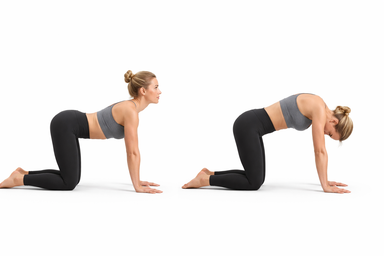
How to
A gentle spine mobility move that alternates rounding and arching your back on hands and knees.
- Start on hands and knees with wrists under shoulders and knees under hips.
- Inhale and drop your belly as you lift your chest and tailbone.
- Exhale and round your back, tucking your chin and tailbone.
- Move slowly between both positions with your breath.
- Move one vertebra at a time.
- Keep your shoulders away from your ears.
- Forcing your neck up or down.
- Rushing through the movement.
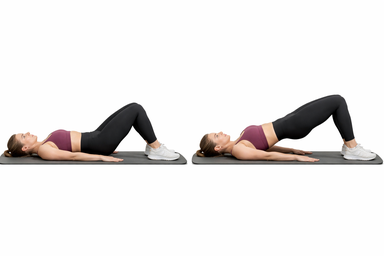
How to
A floor hip lift that trains your glutes and hamstrings with both feet planted.
- Lie on your back with knees bent and feet flat, hip-width apart.
- Brace your core and press your arms lightly into the floor.
- Drive through your heels and lift your hips until your body forms a straight line.
- Squeeze your glutes at the top, then lower with control.
- Repeat for your reps.
- Keep your ribs down
- Drive through your heels
- Arching your lower back at the top
- Pushing through your toes
Circuit A
Lateral hip strength. Keep hips stacked; avoid rolling backward on clamshells.
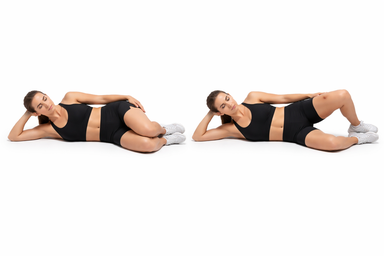
How to
A side-lying hip exercise that trains your glutes and outer hips.
- Lie on your side with knees bent and feet stacked.
- Brace your core and keep your hips stacked.
- Lift your top knee while keeping your feet together.
- Lower your knee with control to the start.
- Finish your reps, then switch sides.
- Keep your hips stacked
- Move slow and controlled
- Rolling your hips back as you lift
- Letting your feet separate
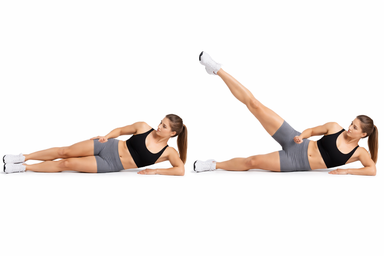
How to
A side-lying leg lift that trains your outer hips and glutes.
- Lie on your side with your legs straight and hips stacked.
- Brace your core and point your top foot straight ahead.
- Lift your top leg up without rolling your hips back.
- Lower with control to the start position.
- Finish your reps, then switch sides.
- Keep your hips stacked.
- Lead with your heel.
- Rolling your top hip back as you lift.
- Swinging the leg instead of controlling it.
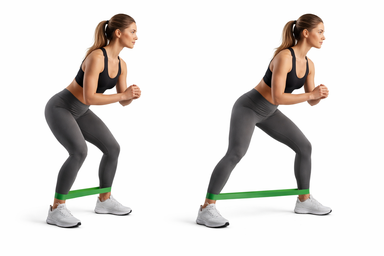
How to
A side-stepping band move that trains your glutes and hips while keeping tension on the band.
- Place a loop band above your knees or around your ankles.
- Stand with feet hip-width apart, knees soft, and hips back slightly.
- Step to one side, then bring the other foot in without losing band tension.
- Keep stepping side to side for your reps, alternating direction as needed.
- Keep your toes facing forward.
- Stay low and controlled.
- Letting your knees cave inward.
- Snapping your feet together between steps.
Circuit B
Single-leg control. Move slowly; keep pelvis level and knee tracking straight.
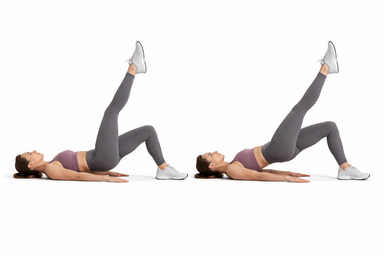
How to
A one-leg bridge that trains your glutes and hamstrings while challenging hip control.
- Lie on your back with one knee bent and the other leg lifted.
- Brace your core and press the planted foot into the floor.
- Lift your hips until your body forms a straight line.
- Lower your hips with control back to the floor.
- Finish your reps, then switch legs.
- Keep your hips level.
- Drive through your heel.
- Letting one hip drop as you lift.
- Arching your lower back at the top.
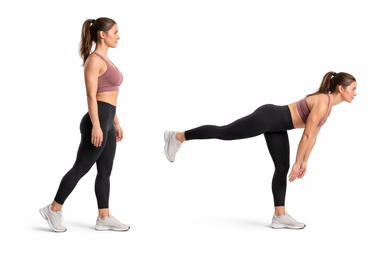
How to
A hip hinge on one leg that trains your hamstrings and glutes while challenging balance.
- Stand tall with weight on one foot and a soft bend in that knee.
- Hinge at your hips as your other leg reaches back behind you.
- Lower your torso until you feel a stretch, keeping your back flat.
- Drive through your standing foot to return to standing.
- Finish your reps, then switch legs.
- Keep your hips square
- Reach long from head to heel
- Rounding your back as you lower
- Opening your hips toward the side
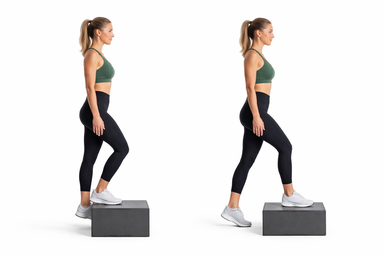
How to
A controlled step from a raised surface that trains your quads, glutes, and balance.
- Stand on a step with one foot near the edge.
- Let the other foot hover off the front of the step.
- Bend your standing knee and lower your free heel toward the floor.
- Tap lightly, then press through your standing foot to return to the top.
- Finish your reps, then switch legs.
- Keep your knee tracking over your toes.
- Move slowly and stay tall.
- Dropping your free foot hard to the floor.
- Letting your standing knee cave inward.
Cool-Down & Core Stability
Finish with lateral core work to support hip stability. 3 minutes.
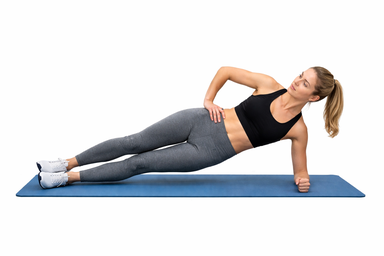
How to
A side hold that trains your obliques, hips, and shoulder stability.
- Lie on one side with your elbow under your shoulder and legs stacked.
- Lift your hips until your body forms a straight line.
- Hold the position and breathe steadily.
- Lower your hips with control.
- Finish your hold, then switch sides.
- Keep your hips stacked
- Press the floor away
- Letting your hips sag
- Rolling your chest toward the floor

Abduction Loads That Build Real Hip Control
Clamshells and side-lying abduction isolate glute medius in its primary role—hip external rotation and abduction—before lateral band walks demand it to stabilize under locomotion. This progression ensures the muscle fires correctly before being loaded dynamically, reducing compensation from TFL or hip flexors.

The Single-Leg Demand Every Runner Ignores
Every step, stride, and landing is a single-leg event, meaning glute medius must resist pelvic drop under bodyweight for milliseconds thousands of times. Weakness here creates a cascade: Trendelenburg gait, IT band overload, and knee valgus. The step-down directly trains this eccentric control at the exact joint angle where most injuries occur.

Isolation-to-Integration Periodization in 25 Minut
This session follows a deliberate activation-to-integration arc—Cat-Cow primes lumbar mobility, isolation moves build motor recruitment, then single-leg deadlifts and step-downs demand full kinetic chain coordination. To personalize, increase lateral band walk resistance only when your pelvis stays level for every rep; compensated reps undo the adaptation.