
Clean & Minimal AI Powered Fitness Routines
Download App25-Minute Intermediate Rucking Endurance
A steady ruck session to build aerobic endurance and posture under load.
25-Minute Intermediate Rucking Endurance
A steady ruck session to build aerobic endurance and posture under load.
Warm-Up Walk
Easy pace. Focus on posture, breathing, and comfortable stride.
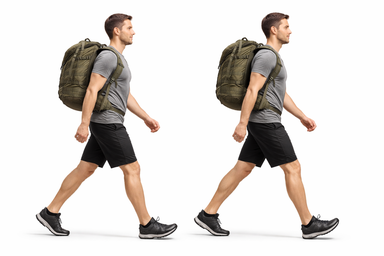
How to
A loaded walk with a pack or vest that trains your legs, core, and posture.
- Put on the pack or vest and stand tall with feet hip-width apart.
- Brace your core and keep your shoulders down and back.
- Walk at a steady pace with short, controlled steps.
- Keep your chest up and eyes forward as you breathe evenly.
- Finish the set time or distance, then set the load down safely.
- Stand tall under the load
- Take smooth, steady steps
- Leaning far forward under the weight
- Letting the pack bounce with each step
Main Intervals
Alternate steady and brisk pace. Brisk = faster steps, not a jog.
How to
A loaded walk with a pack or vest that trains your legs, core, and posture.
- Put on the pack or vest and stand tall with feet hip-width apart.
- Brace your core and keep your shoulders down and back.
- Walk at a steady pace with short, controlled steps.
- Keep your chest up and eyes forward as you breathe evenly.
- Finish the set time or distance, then set the load down safely.
- Stand tall under the load
- Take smooth, steady steps
- Leaning far forward under the weight
- Letting the pack bounce with each step
Cool-Down Walk
Easy pace. Let breathing return to normal and maintain tall posture.
How to
A loaded walk with a pack or vest that trains your legs, core, and posture.
- Put on the pack or vest and stand tall with feet hip-width apart.
- Brace your core and keep your shoulders down and back.
- Walk at a steady pace with short, controlled steps.
- Keep your chest up and eyes forward as you breathe evenly.
- Finish the set time or distance, then set the load down safely.
- Stand tall under the load
- Take smooth, steady steps
- Leaning far forward under the weight
- Letting the pack bounce with each step

Why Sustained Load Walking Builds Base
The Ruck Walk targets your posterior chain—glutes, erectors, and trapezius—while simultaneously taxing your aerobic energy system at a submaximal intensity. Carrying load shifts your center of gravity, forcing constant postural micro-corrections that build functional core stability you can't replicate with bodyweight alone.

The Hidden Demands of Weighted Locomotion
Rucking sits in a unique physiological zone: too heavy to ignore, too slow to be running—meaning your slow-twitch fibers and connective tissue absorb cumulative stress across every step. The 25-minute duration is no accident; it targets the aerobic threshold window where fat oxidation and cardiovascular adaptation peak without overwhelming recovery capacity.

Load Progression Is Your Primary Variable
Rucking follows a specificity principle where pack weight and duration are your levers—not sets or reps. Start conservative with load (10–15% bodyweight), lock in your 25-minute pace, then add weight in 5-pound increments only after three consecutive sessions feel controlled. Your actionable cue: if your forward lean exceeds 5 degrees, the load is too heavy for your current postural endurance.