
Clean & Minimal AI Powered Fitness Routines
Download AppPeke the Powerhouse — Hard CrossFit-Style Strength and Metcon
A high-intensity CrossFit-style session built for Peke the powerhouse, with low-back-friendly strength, conditioning, and mobility.
Peke the Powerhouse — Hard CrossFit-Style Strength and Metcon
A high-intensity CrossFit-style session built for Peke the powerhouse, with low-back-friendly strength, conditioning, and mobility.
Mobility Flow
Smooth reps, nasal breathing if possible.
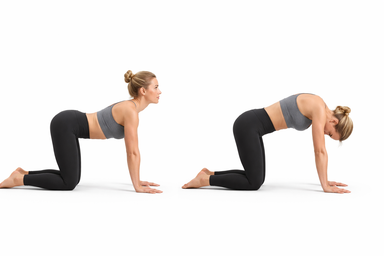
How to
A gentle spine mobility move that alternates rounding and arching your back on hands and knees.
- Start on hands and knees with wrists under shoulders and knees under hips.
- Inhale and drop your belly as you lift your chest and tailbone.
- Exhale and round your back, tucking your chin and tailbone.
- Move slowly between both positions with your breath.
- Move one vertebra at a time.
- Keep your shoulders away from your ears.
- Forcing your neck up or down.
- Rushing through the movement.
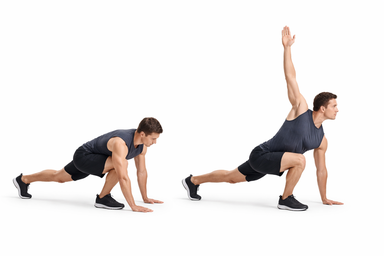
How to
A dynamic lunge stretch that opens your hips, hamstrings, and upper back as you alternate sides.
- Start in a high plank with hands under shoulders.
- Step your right foot outside your right hand.
- Drop your hips, then rotate your right arm up toward the ceiling.
- Place your hand down and step back to plank.
- Repeat on the left side, alternating sides each rep.
- Keep your front foot flat.
- Reach long through your top hand.
- Letting your front heel lift off the floor.
- Rushing the rotation without control.
Activation
Light to moderate load. Focus on bracing and shoulder positioning.
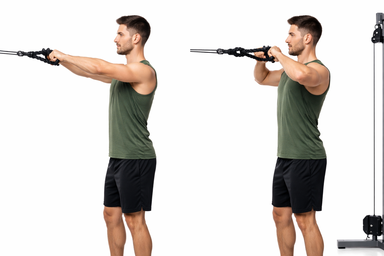
How to
A cable pull to face height that trains your upper back and rear shoulders.
- Set the cable at upper-chest height and grip the rope with both hands.
- Step back until your arms are straight and the cable is taut.
- Pull the rope toward your face, elbows high and out to the sides.
- Squeeze your shoulder blades, then return with control.
- Keep your ribs down
- Lead with your elbows
- Shrugging your shoulders toward your ears
- Leaning back to move the weight
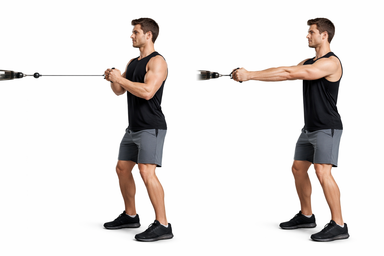
How to
An anti-rotation cable hold that trains your core as you resist the pull from one side.
- Stand side-on to the cable with the handle at chest height.
- Hold the handle with both hands at the center of your chest.
- Step away until you feel tension, then brace your core.
- Press your hands straight out and hold, breathing steadily.
- Bring your hands back to your chest with control.
- Finish the hold, then switch sides.
- Keep your ribs down
- Do not let your torso rotate
- Leaning toward or away from the cable
- Letting the handle drift off center
Strength
Hard, low-back friendly. Unilateral leg strength, pulling, and pressing with minimal spinal loading.
How to
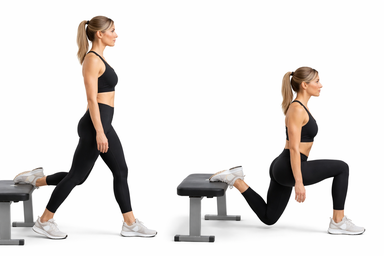
A rear-foot-elevated split squat that trains your quads, glutes, and balance.
- Stand a stride in front of a bench or step, facing away.
- Place the top of one foot on the bench behind you.
- Bend your front knee and lower until your back knee moves toward the floor.
- Press through your front foot to stand tall again.
- Finish your reps, then switch legs.
- Keep your chest up.
- Keep your front knee tracking over your toes.
- Pushing off the back foot too much.
- Letting your front knee cave inward.
How to
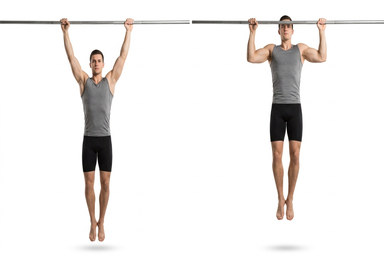
A bodyweight upper-body pull that trains your back, shoulders, and arms.
- Grip the bar with hands just wider than shoulder width.
- Hang with arms straight and brace your body.
- Pull your chest toward the bar by driving elbows down.
- Pause briefly at the top with chin over the bar.
- Lower with control until your arms are straight again.
- Keep your ribs down
- Lead with your chest
- Kicking your legs to start the pull
- Shrugging your shoulders toward your ears
How to
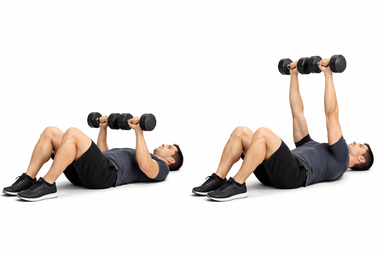
A floor chest press with dumbbells that trains your chest, shoulders, and triceps.
- Lie on your back with knees bent and a dumbbell in each hand.
- Set upper arms on the floor, elbows about 45 degrees from your body.
- Press the dumbbells up until your arms are straight over your chest.
- Lower with control until your upper arms lightly touch the floor.
- Repeat for reps.
- Keep wrists stacked over elbows.
- Press both dumbbells evenly.
- Bouncing your arms off the floor.
- Letting elbows flare straight out.
Metcon
Powerhouse grinder. High-intensity conditioning with back-friendly movement choices. Push pace, keep form.

How to
A full-body bodyweight move that combines a squat, plank, push-up, and jump to train power and conditioning.
- Stand with feet about hip-width apart and arms at your sides.
- Squat down and place your hands on the floor.
- Jump or step your feet back to a strong plank.
- Lower your chest toward the floor, then press back up.
- Jump or step your feet back in and stand tall.
- Jump up with arms overhead, then land softly and repeat.
- Brace before you jump back.
- Land with soft knees.
- Letting your hips sag in the plank.
- Crashing down into the floor.
How to
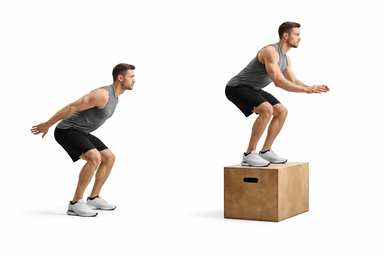
A two-foot jump onto a box that trains explosive leg power and landing control.
- Stand facing the box with feet hip-width apart.
- Dip your hips and swing your arms back.
- Jump with both feet and land softly on the box.
- Stand tall on the box, then step down with control.
- Repeat for reps.
- Land with knees tracking over toes.
- Use your arms to help drive up.
- Landing stiff-legged on the box.
- Jumping down if you cannot control it.
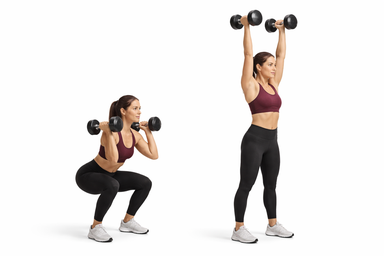
How to
A squat into an overhead press that trains your legs, shoulders, and core.
- Stand with feet shoulder-width and hold dumbbells at your shoulders.
- Brace your core and squat down with your chest up.
- Drive through your feet and stand up hard.
- Use that drive to press the dumbbells overhead.
- Lower the dumbbells to your shoulders and repeat.
- Keep your chest up
- Press in one smooth motion
- Letting your knees cave in
- Arching your back as you press
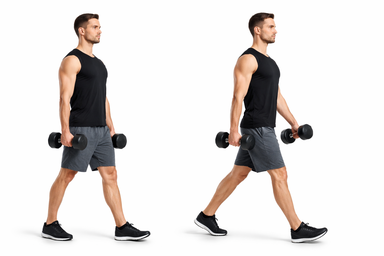
How to
A loaded walk that trains your grip, core, shoulders, and posture.
- Stand tall with a weight in each hand at your sides.
- Brace your core and pull your shoulders down and back.
- Walk forward with short, controlled steps.
- Keep the weights steady and your torso upright.
- Set the weights down with control when finished.
- Stand tall as you walk
- Keep the weights by your sides
- Leaning back or to one side
- Letting the weights swing
Cool-Down
Yoga and mobility. Downshift breathing, open hips and thoracic spine, and relax the back.
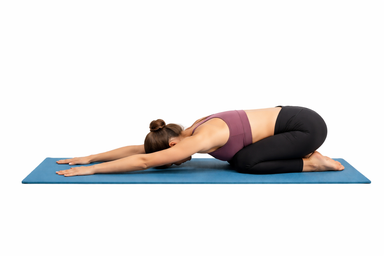
How to
A kneeling rest stretch that relaxes your back, hips, and shoulders while you breathe.
- Kneel with your big toes together and knees apart.
- Sit your hips back toward your heels.
- Reach your arms forward and lower your chest to the floor.
- Rest your forehead down and relax your neck.
- Hold the stretch and breathe slowly.
- Let your hips sink back
- Keep your neck relaxed
- Forcing your hips down
- Holding your breath
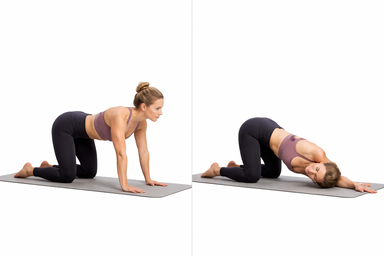
How to
A floor stretch that opens your upper back and shoulder while you hold one side at a time.
- Start on all fours with your hands under shoulders and knees under hips.
- Slide one arm under your chest, palm up, and lower your shoulder toward the floor.
- Rest your head down if comfortable, and keep your hips over your knees.
- Hold the stretch and breathe slowly.
- Press into your top hand to return to all fours, then switch sides.
- Keep your hips stacked over your knees
- Breathe into your upper back
- Letting your hips drift far to one side
- Forcing your shoulder lower than comfortable
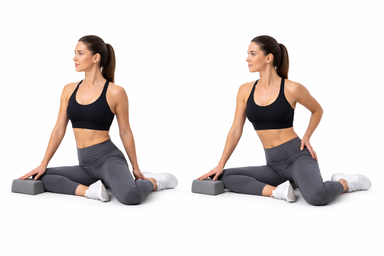
How to
A seated hip stretch that opens both hips and trains control in the 90/90 position.
- Sit tall with your front knee bent to 90 degrees.
- Place your back leg to the side, also bent to 90 degrees.
- Square your chest over your front shin as much as you can.
- Hold the position and breathe slowly.
- Switch your legs and repeat on the other side.
- Keep your spine long.
- Move only as far as you can control.
- Collapsing your chest or rounding your back.
- Forcing your knees to the floor.

Why These Exercises Were Chosen
Each exercise targets specific muscle groups and movement patterns matched to the demands of your discipline. The selection balances agonist-antagonist pairs, stabilizer engagement, and energy system development to build functional capacity that transfers directly to performance.

Built Around How Your Body Works
Your routine reflects the biomechanical and physiological demands of your goal. Joint angles, contraction types, and loading patterns are chosen to strengthen exactly the positions and forces your body encounters during your activity.

Structured for Long-Term Adaptation
Set and rep schemes follow progressive overload principles, giving your tendons, muscles, and nervous system the stimulus they need to adapt. Adjust load and rest periods as movements become easier to keep driving improvement.