
Clean & Minimal AI Powered Fitness Routines
Download AppIntermediate Knee Osteoarthritis Routine
Low-impact strength + mobility to support knee-friendly movement in ~25 minutes.
Intermediate Knee Osteoarthritis Routine
Low-impact strength + mobility to support knee-friendly movement in ~25 minutes.
Warm-Up
Gentle joint prep. Increase circulation and lubricate the knee joint before strengthening.
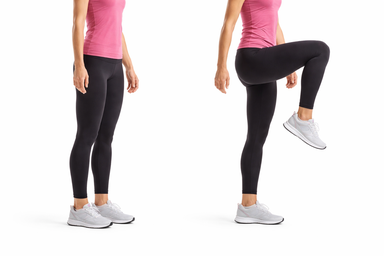
How to
A low-impact cardio move that warms up your legs and hips while raising your heart rate.
- Stand tall with your feet hip-width apart and arms at your sides.
- Lift one knee to hip height as you swing the opposite arm forward.
- Lower that foot, then lift the other knee and switch arms.
- Keep alternating sides at a steady pace.
- Slow down and plant both feet to finish.
- Stand tall with your chest up
- Land softly under your hips
- Leaning back as you lift your knees
- Stomping your feet on each step
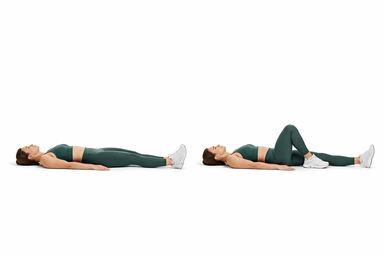
How to
A lying leg slide that trains core control and hip movement one side at a time.
- Lie on your back with knees bent and feet flat.
- Brace your core and keep your low back steady.
- Slide one heel away until your leg is almost straight.
- Pull the heel back to the start with control.
- Finish your reps, then switch legs.
- Move slowly and stay braced.
- Keep your pelvis still.
- Arching your lower back as the leg slides out.
- Letting your hips rock side to side.
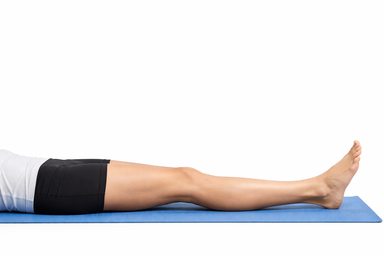
How to
An isometric thigh squeeze that trains your quadriceps with your leg straight.
- Sit or lie with one leg straight and the other relaxed.
- Flex your foot and press the back of your knee gently down.
- Tighten your thigh and hold, breathing steadily.
- Relax fully after the hold.
- Finish your holds, then switch legs.
- Keep your kneecap facing up
- Squeeze the front of your thigh
- Holding your breath
- Lifting your heel as you squeeze
Circuit A
Use a chair for support. Keep the knee tracking over toes; avoid deep angles if painful.
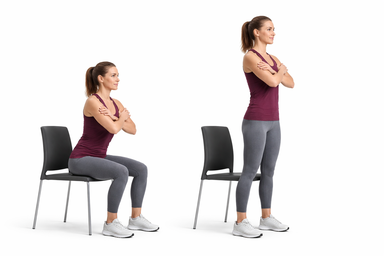
How to
A chair-based squat pattern that trains your thighs and glutes for standing strength.
- Sit near the front of a chair with feet flat and hip-width apart.
- Lean slightly forward and brace your core.
- Press through both feet and stand tall.
- Push your hips back and sit down with control.
- Keep your knees tracking over your toes
- Stand tall at the top
- Letting your knees cave inward
- Dropping hard onto the chair
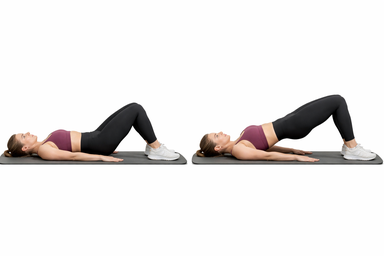
How to
A floor hip lift that trains your glutes and hamstrings with both feet planted.
- Lie on your back with knees bent and feet flat, hip-width apart.
- Brace your core and press your arms lightly into the floor.
- Drive through your heels and lift your hips until your body forms a straight line.
- Squeeze your glutes at the top, then lower with control.
- Repeat for your reps.
- Keep your ribs down
- Drive through your heels
- Arching your lower back at the top
- Pushing through your toes
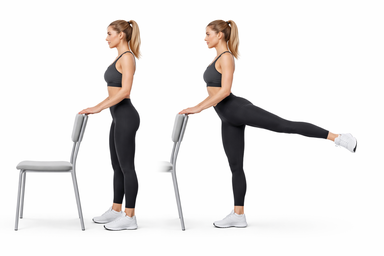
How to
A standing leg raise to the side that trains your outer hips and balance.
- Stand tall with one hand on a wall or chair for balance.
- Shift your weight onto one leg and brace your core.
- Lift the other leg out to the side without leaning your torso.
- Lower the leg with control to the start position.
- Finish your reps, then switch legs.
- Keep your toes facing forward.
- Stand tall through each rep.
- Leaning your torso to lift the leg.
- Turning your toes outward as you raise.
Circuit B
Step height should be low (bottom stair or sturdy platform). Hold the chair/rail lightly.
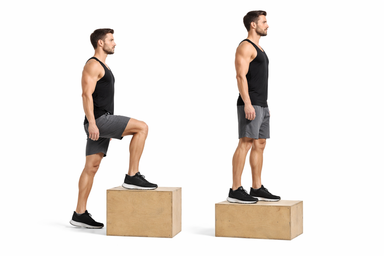
How to
A single-leg climb onto a step that trains your quads, glutes, and balance.
- Stand facing a sturdy step with one foot fully on top.
- Lean slightly forward and drive through the front foot to stand up.
- Bring your back foot onto the step with control.
- Step back down with the same back foot, then lower the front foot.
- Finish your reps, then switch legs.
- Keep your chest tall
- Drive through your whole front foot
- Pushing off too much with the back foot
- Letting your front knee cave inward
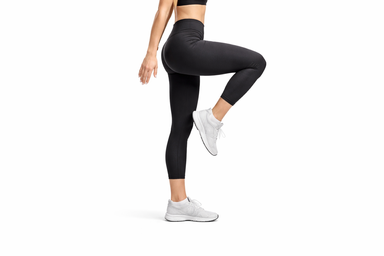
How to
A one-leg balance hold that trains stability in your foot, ankle, and hip.
- Stand tall with feet hip-width apart and arms relaxed.
- Shift your weight onto one foot and lift the other foot off the floor.
- Hold steady and breathe, keeping your body tall.
- Lower your foot with control when the hold is done.
- Finish your hold, then switch legs.
- Keep your hips level
- Stand tall through your crown
- Leaning your torso far to one side
- Letting your lifted foot rest on the floor
Cool-Down
Mobility and stretch. Downshift and restore comfortable range of motion around the knee and ankle.
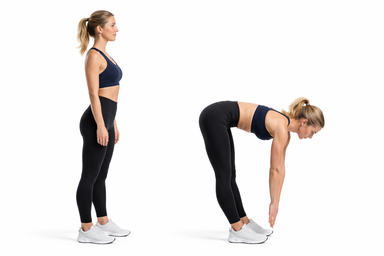
How to
A held stretch for the back of your thigh that targets your hamstrings.
- Sit tall with your target leg straight and toes up.
- Hinge at your hips and reach toward your foot.
- Stop when you feel a gentle stretch behind your thigh.
- Hold the stretch and breathe slowly.
- Release slowly, then switch sides if stretching one leg.
- Keep your back long.
- Hinge from your hips.
- Rounding your back to reach farther.
- Bouncing in the stretch.
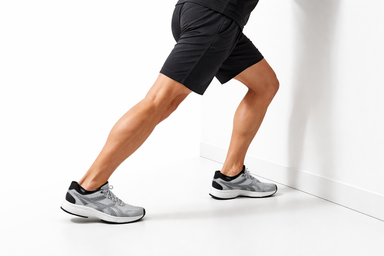
How to
A standing calf stretch that targets the back of your lower leg with a steady hold.
- Stand facing a wall and place your hands on it.
- Step one foot back and keep that heel on the floor.
- Bend your front knee until you feel a calf stretch.
- Hold and breathe slowly without bouncing.
- Finish the hold, then switch legs.
- Keep your back heel down
- Point both toes forward
- Bouncing in the stretch
- Letting the back heel lift

Loading Cartilage Without Crushing It
Quad Sets and Heel Slides build quadriceps activation and synovial fluid circulation without compressive joint load — the exact stimulus arthritic cartilage needs to stay nourished. Sit to Stand and Step Ups then introduce controlled weight-bearing to rebuild the quad-to-bodyweight strength ratio that erodes fastest with knee OA.

Why the Quad-Hip Connection Is Everything
Knee OA progressively shifts load away from weakened quads onto passive structures, accelerating degeneration. Glute Bridges and Standing Hip Abduction target the hip abductors and posterior chain that stabilize your femur over your tibia — reducing the shear forces that make every step feel like grinding glass.

Sequencing Pain-Free Movement Patterns
This routine follows a deliberate activation-to-loading arc: non-weight-bearing exercises prime the neuromuscular system before upright tasks demand it. Single-Leg Stand builds proprioceptive feedback that OA systematically degrades. Progress Step Up height or Bridge repetitions before adding any external load to keep adaptation outpacing inflammation.